The Homey Pro Mini is a more affordable, miniature version of the $400 Homey Pro.At half the price, while still being performant and easy to use, the Homey Pro Mini is one of the easiest smart home hubs to recommend to anyone looking to start or upgrade their smart home.Homey Pro Mini 9 Connectivity Matter, Thread, Zigbee, Ethernet Wi-Fi No Color Black The Homey Pro mini is a $200 hub with an intuitive app and support for the most popular smart home connectivity standards.
At half the price of the Homey Pro, the Homey Pro mini is a more affordable foundation for a smart home and one that's easy to recommend. Pros & Cons Supports most common connectivity standards Intuitive setup and app Much simpler than Home Assistant Still a dedicated hub that doesn't serve a dual-purpose in the home Uncertainty over what future changes Homey's new owner, LG, might make $200 at Amazon $200 at Best Buy Expand Collapse See Our Process How We Test and Review Products at How-To Geek We go hands-on with every product to ensure it's worth your time and money.Posts By Justin Duino Price and availability The Homey Pro Mini costs $200.It is available directly from Homey along with Amazon, Best Buy, and Walmart.
It only comes in black.Specifications Connectivity Matter, Thread, Zigbee, Ethernet Wi-Fi No Color Black Expand Collapse A local-first, mostly private smart home hub Bringing control of your smart home into your home Homey isn’t a new name in the smart home world.The Dutch company has produced several iterations of smart home hubs over the past decade, but the existing Homey Pro's $400 price is steep for a product that, unlike an Apple HomePod or Samsung Frame TV, doesn’t serve any other purpose.
This leads us to the company’s latest hub, the Homey Pro Mini.The Mini halves the price by reducing the processing power and number of supported types of connections.In the process, Homey has managed to deliver a hub that’s more reasonable to recommend without sacrificing functionality for the majority of buyers.
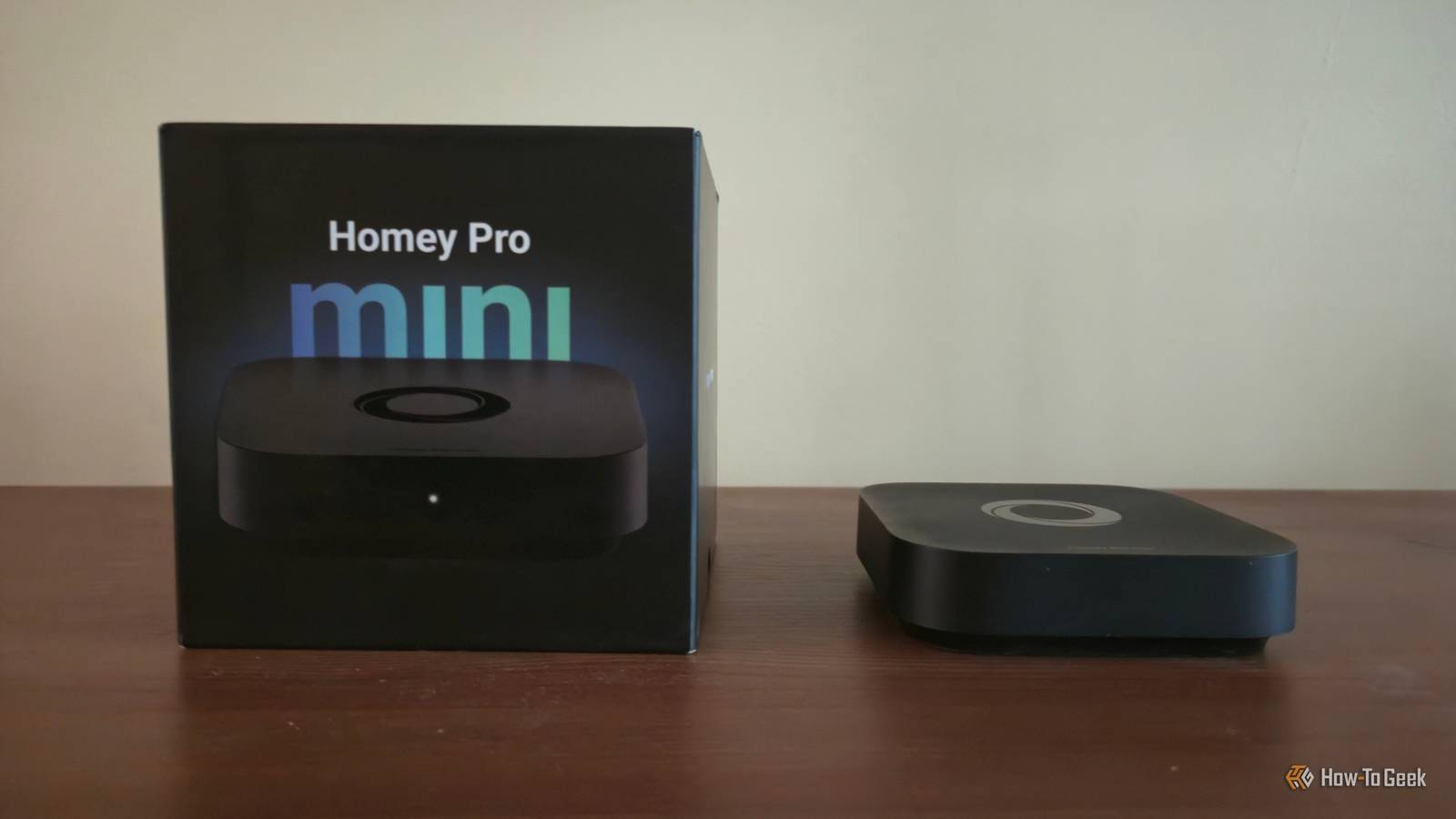
The Homey Pro Mini is a small black square around the size of a TV streamer box.Spec-wise, the Homey Pro Mini has a quad-core 1.5GHz ARM processor, 1GB of LPDDR4 RAM, and 8GB of eMMC storage.Of these, only the RAM is different from that of the Honey Pro, which comes with 4GB.
The Mini is able to manage smart home devices via Matter, Zigbee, Thread, and direct Ethernet connections.Compared to the Pro, you’re losing support for Z-Wave, infrared, and 433MHz.If you find you do need those extra connections down the line, you can purchase a $70 Homey Bridge that will allow your Mini to control those Z-Wave, IR, and 433MHz devices.
The setup process consists of plugging in a USB-C cable for power and using an Ethernet cable to connect the hub to your home network.Unlike the Pro, there is no built-in Wi-Fi.Once up and running, you must install the Homey Android or iPhone app.
The inability to set up the Homey Pro Mini using a web browser is a bummer, but there is a web app available once everything is up and running.That said, the mobile app is one of the best things about Homey.An app anyone in the house can use You won't need Reddit and YouTube to figure it out There aren’t many companies that serve as direct competitors to Homey.
SmartThings began as a smart home hub that existed solely to control the smart devices in your home, but since being purchased by Samsung, it’s now an internet-dependent cloud service much like Amazon Alexa and Google Home.Speaking of acquisitions—Homey is now a LG subsidiary.So far, Homey’s new corporate owners haven't imposed any noticeable changes onto Homey, but that is something to keep in mind.
After all, LG purchased Homey in part to gain insights into user behavior, which seemingly runs counter to Homey's emphasis on privacy.For the time being, however, Homey’s privacy policy shows less data collection than the cloud-based commercial platforms.The number of people looking to purchase a smart home hub isn’t huge, and many of those who are interested end up using Home Assistant for free.
After all, free is a hard price to compete with—so much so that Homey has also released a free version for you to self-host on your own hardware.But as a paid product, Homey has two things working in its favor: Home Assistant requires technical knowledge to get set up (unless you opt to purchase Home Assistant Green), and it isn’t the most intuitive software even once up and running.I wouldn’t feel comfortable recommending Home Assistant to most of the non-computer-savvy people in my life, nor would I recommend it to many of the computer-savvy ones, either.
A steep learning curve is something you have to want to make time for.Homey is a different story.Homey’s app does, sadly, require setting up an online account, but the app then makes simple work of guiding you through the process of setting up your hub, replicating the rooms in your home, and adding your first device.
The interface is similar to Apple Home, but with added flexibility for those who want it, as well as cross-compatibility—you can control Homey using Alexa, Google, or Siri.Close There’s a dashboard tab for setting up precisely what information and devices you wish to see when opening the app, which can be particularly useful if you’re setting up a tablet running Homey as a dedicated control panel.There’s also an energy tab where you can monitor the power your home generates via solar panels and where that energy is going, assuming you have the necessary hardware.
Our home has rooftop solar, but we lack any type of energy monitoring equipment, so while I can use Homey to track production, I don't have insight into consumption.Close Homey refers to automations as "flows," which you can create by adding "cards." These cards consist of either conditions or actions.One card can be "motion is detected" while another is "turn the lights on." Put the two cards together, and you have lights that come on when motion is detected.
Like other smart home platforms, automations are performed as if-then statements, but in Homey you have the option to use drag and drop.While you can drag cards around in the mobile app, the functionality really comes into its own in the web app, where you have the screen space to work with larger flows.Close Power without the complexity If you can imagine it, there's a good chance Homey can do it The Homey Pro Mini is perhaps the closest thing you can buy to a proprietary, consumer-ready version of Home Assistant.
While the former isn't open source, it is easier to use by many orders of magnitude.You don’t need to figure out why each device has both a name and an "entity ID" or how disabling, hiding, and deleting a device are all different things.I have yet to see Homey present so much information at one time that it feels like I'm looking at a spreadsheet or backend software.
In Homey, tasks are straightforwardly easy to understand.Deleting a device is as simple as it is on an Apple or Google platform, with little likelihood that you’ll end up with ghost devices because you didn’t realize you got rid of a device in the wrong way.Creating automations, again, is as simple as dragging and dropping cards.
One of the beauties of Home Assistant is that you can integrate it with third-party services.Whereas you can’t control SmartThings appliances from Google Home or using Amazon Alexa, you can mix and match ecosystems using Home Assistant.A similar flexibility is available via Homey.
In Homey, you add this third-party integration by installing “apps” within the Homey app (here is the one area where I feel like Homey’s language is a bit less intuitive).By apps, Homey primarily means third-party integrations.I’ve installed apps for Enphase (which manages my solar panels) and SmartThings (my fridge, dishwasher, and TV).
Other available apps include IKEA, Phillips Hue, Sonos, and Spotify.Some apps do serve other purposes, however, such as the Power by the Hour app that expands on the information you’re able to see from a smart meter and the automations you can perform based on these insights.Close I appreciate these apps being available, but their quality is hit or miss.
While the data in Homey matches the solar production shown in the Enphase Android app, Homey’s SmartThings app thinks the temperature in my fridge is 104 degrees Farenheit.I’ve checked, and I can confirm that the temperature is not, in fact, hotter than the rest of the house.That said, I installed the Homey team’s SmartThings app, but there are two other community-created options available as well that may not have this issue.
And if you really want to take matters into your own hands, there's the HomeyScript app, which allows you to create automations via a JavaScript-based language if you find the cards not enough.Personally, while I'm glad the power is there, I’m not interested in tapping into it—I have yet to want to do something with smart devices that I couldn’t easily do with cards.At the end of the day, a Homey Pro Mini is intuitive for beginners while being more powerful than the cloud-based platforms.
It doesn’t match the sheer breadth of what you can do with Home Assistant, but it also doesn’t require reading FAQ pages, blog posts, Reddit, and binging YouTube tutorials in order to figure out.Don't let the "mini" fool you This is all the hub I need Despite having one-forth the RAM as the Homey Pro, the Mini has been speedy throughout my entire time with the device, and it has no problems controlling my dozens of smart devices.Keep in mind—I’ve installed around 50 smart switches in my home, in addition to floor lamps, portable smart lights, a smart thermostat, some smart thermometers, an air quality monitor, and more.
All of these devices are Matter devices, which makes the Homey Pro Mini an ideal fit for me even without the optional bridge.I only started building a smart home in the past year, so I don't have Zibgee or Z-Wave devices lying around.Most of my tech operates over Wi-Fi, though thanks to IKEA, I'm rapidly increasing the number that connect using Thread.
Inside the Homey app, there isn't a noticeable difference between the two unless you actively look.I have been pleased by the reliability of the hub.Unlike my time with Home Assistant, if a device shows up as offline, I can generally be confident the issue is with the target device, not the hub.
Uptime has been impressive.The hub has been online whenever I've tried to access it, and there is no difference in the experience whether I’m opening the app from inside or outside my home.Should you buy the Homey Pro Mini? The Homey Pro Mini and Homey Bridge combined come out to a much lower price than the Homey Pro, and I'm willing to bet most of us won't even notice the decreased RAM.
If you're completely new to Homey, I'd say the Mini is the one to get.If you want an intuitive and reliable smart home hub that isn't uploading your every action to the web, Homey’s latest hub fits the bill.LG's purchase of Homey does put a question mark on what the future holds, but I can only review the product that I have in front of me today—a remarkably versatile piece of kit with one of the most plain English privacy policies I've read in quite some time.
I hope that doesn't change, because for the time being, there isn't another local smart home hub that balances capability and ease-of-use quite as well as this.Homey Pro Mini 9 Connectivity Matter, Thread, Zigbee, Ethernet Wi-Fi No Color Black The Homey Pro mini is a $200 hub with an intuitive app and support for the most popular smart home connectivity standards.At half the price of the Homey Pro, the Homey Pro mini is a more affordable foundation for a smart home and one that's easy to recommend. $200 at Amazon $200 at Best Buy Expand Collapse
Read More