Death is the one guarantee in this world.Ask Borys Wróbel, though, and it’s just the beginning.Wróbel is the chief scientist at Nectome, a Portland-based start-up that is looking into ways to preserve the human brain and body.
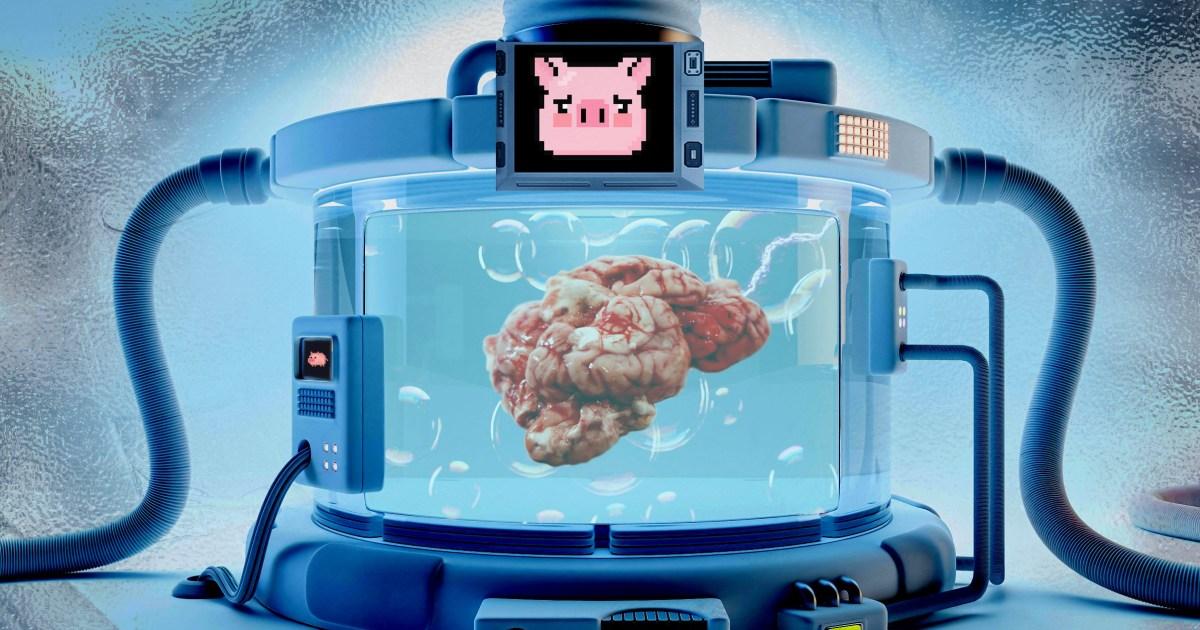
Together with Aurelia Song and Anna LaVergne, Wróbel came one step closer to this goal last month by managing to preserve a pig’s body and brain.This could pave the way for uploading humans brains to computers – one day, Wróbel tells Metro.‘It’s a huge loss to us as humanity to be losing the experience of people every day,’ he says.
Up Next ‘Think about the wisdom of people who lived through World War Two.It’s a different thing, to be able to talk to someone and ask them questions, than to look at memoirs or reports.’ Comparing his protocol to dialling the hands of a time machine, Wróbel says the tech could offer people in the year 3000 the chance to speak with people alive right now.The findings are a preprint, a copy of a paper that has yet to be peer-reviewed, Wróbel stresses, which is why he’s keen to carry out more tests.
How… did they do that? Some neuroscientists believe that everything that makes you, you, is inside the 100 trillion connections in our brains.But mapping the brain’s unimaginably vast and complex network known as the connectome isn’t an easy thing to do.Ice is enemy number one of neuroscientists, as it crushes cells as it forms, so out goes throwing a brain into a freezer.
You can’t just use anti-freeze either, as it’s toxic.Neuroscientists’ second enemy is time.Unless the team is at a person’s bedside, the brain will already have begun to deteriorate by the time they get to work.
To bypass these, Nectome inserted a tube into a pig’s heart 10 minutes after the pig suffered a cardiac arrest to flush the blood.(Pigs have brain and cardiovascular anatomy similar to humans.) Early attempts made 18 minutes after death weren’t as successful.They then injected preservation fluids that contain aldehyde chemicals to glue the cells together.
The solution, called a cryoprotectant, replaces the water flowing within tissue so jagged ice doesn’t form when the brain is cooled to -32°C.‘If we wanted, we could lower this temperature so much that everything would become solid without forming crystals.It will turn the tissue, the whole body, into a glassy state,’ Wróbel explains.
‘…Nothing is alive there, per se; life as we know it can’t continue.It’s just to see the structure and be able to maintain that information.‘We think we can actually calculate that we could keep those brains for hundreds of years.’ The paper says that the knitty-gritty of the brain – the neurons that govern speech, motor function and thought and the connection points between them, synapses – were largely unspoiled.
This is quite a big deal.After all, the most comprehensive 3D map of a mammalian brain to date, which took seven years to make, is still only a small section of a mouse’s.When could this happen? Up Next Wróbel hopes that our brains – his included – might be preserved so that a future civilisation could bring the mind back.
By ‘mind’, Wróbel means a thinking, feeling and remembering mind that would wake up with all your thoughts, memories and thinking patterns.Unlike cyrogenics, which preserves people by cooling them, Wróbel is talking about ‘reanimation’.Preserve brains well enough, and scientists could analyse their structure and use this to recreate them, whether in engineered living tissue or in a computer with a robotic body. ‘This is not something that we could do right now with current technology, reverse and bring those brains back to life,’ Wróbel adds.
Wróbel isn’t going to grab people off the street and scoop out their brains.Nectome is asking people who are terminally ill to come to Portland, Oregon, and donate their brains and bodies for science.Oregon has a law called ‘Death with Dignity’ which permits doctors, after a complex process of requests and waiting periods, to prescribe lethal medication for dying patients to self-ingest.
‘That person would be interested in generously donating the brain to scientific research so that we can investigate whether it can actually be done in humans,’ Wróbel says.Could ‘reanimation’ be the death of death? Ben Goult, a professor of mechanistic cell biology at the University of Liverpool, wonders how ‘conscious’ a reanimated brain could be.‘Conscious experience is deeply embedded in bodily signals and interactions with the environment,’ he says.
‘A brain brought into awareness could never be a true restoration of the person it once was..Bethany Facer, a neuroscientist also at the University of Liverpool, says taking a snapshot of the brain’s circuitry doesn’t capture all the complex activity inside it.Trending Now Teenager killed by 'family dog who slept on her bed' named UK 16 hours ago By Noora Mykkanen Boy, 9, loses ability to walk after being locked in dad's van for nearly 500 days Cars surrounded with windows smashed after large crowd takes over London park Artemis II astronauts struggle to walk back on Earth after 'perfect splashdown' landing ‘However, the fact that we’re even having this conversation shows how far neuroscience has come,’ she adds.
‘The questions this raises are very interesting, we’re just a very long way from having the answers.’ Eric Klein, the founder of the Lifeboat Foundation, an existential risk reduction non-profit, longs for the day the answers arrive.‘It’s a fascinating technique in an age where existential risks are posing threats to our survival from all sides,’ the cryonicist says.‘With over 10 million people walking around on the planet after having spent some time frozen as embryos, it is fascinating when attempts are made to preserve people so they can be revived in the future.’ Get in touch with our news team by emailing us at [email protected].
For more stories like this, check our news page.MORE: Woman killed on evening walk with husband after decaying tree collapses MORE: Two teenagers arrested after cyclist in his 70s ‘punched to death’ MORE: The three Ps of pooing you need to master for effortless bowel movements Comments Add as preferred source News Updates Stay on top of the headlines with daily email updates.This site is protected by reCAPTCHA and the Google Privacy Policy and Terms of Service apply.
Your information will be used in line with our Privacy Policy HomeNewsTech Related topics DeathPigScience There's a chance aliens are hitching a ride on the moons of rogue planets Tech 5 days ago By Josh Milton AI will lie, cheat and disobey humans to 'protect their own kind', study shows Tech 14 hours ago By Josh Milton
Read More