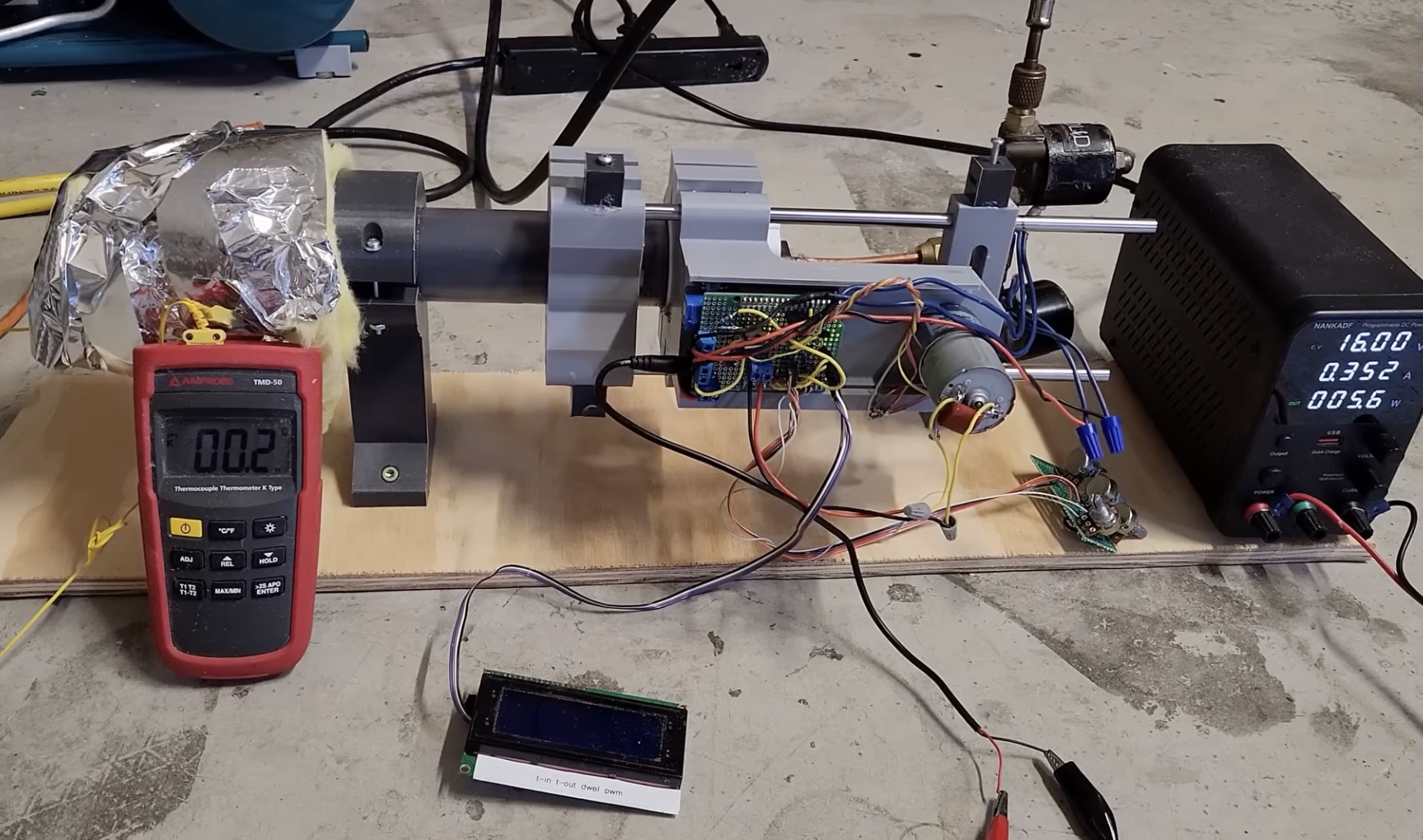
If you want some very cold air, you’re going to have to dive deep into thermodynamic wizardry to find a practical way to get it.Hyperspace Pirate did that digging and discovered the Gifford-McMahon cryocooler design.That is just simple enough that Hyperspace Pirate was able to build his own cryocooler using 3D printed parts and an Arduino.
You may have noticed that air compressors get very hot when you run them.Conversely, compressed air gets pretty cold when you release it.Compression increases temperature, while expansion lowers temperature. If you were to repeat the compression and expansion cycle over and over, you’d end up with a net increase in temperature due to inefficiency.
But a Gifford-McMahon cryocooler “cheats’ by separating the cold part of the system from the hot part of the system.It consists of a chamber within a piston inside, which moves back and forth to move air to the cold side or hot side (input comes from an external air compressor).The piston is hollow and filled with material that readily transfers and retains heat (lead shot in this case), which helps with the transition between sides. The result is progressive net cooling of the air inside — though the air outside gets warmer.
Hyperspace Pirate built his Gifford-McMahon cryocooler on a budget.It is really just a cylinder with a piston inside.But it is sealed, so an external actuator moves the piston with magnets.
An Arduino UNO Rev3 controls the rotation of a stepper, translated into linear motion to move the cylinder in and out.Originally limit switches detected the ends of the stroke, but Hyperspace Pirate switched to Hall effect sensors.Because he used an Arduino, Hyperspace Pirate was able to time the piston movement to match the opening of the cylinder’s valve.
With this approach, Hyperspace Pirate reached temperatures as low as -70°C.That isn’t quite cryogenic, but it is very cold.It would have been possible to go lower with very dry air (or another gas), but those temperatures caused ice to build up and stall the system.
Even so, -70°C is very impressive and useful for all kinds of work, which is great for such a low-cost cryocooler.
Read More