While most of the 3D printed construction hype has been around houses, we’re more bullish on infrastructure.By 3D printing in hard-to-reach areas, remote structures can bring infrastructure to new places cost-effectively.In remote areas, 3D printing is even more cost-effective, and implementation can save time and money.
We initially thought of examples such as remote military construction, energy infrastructure in far-off places, and things like wastewater infrastructure in India.But it turns out you can also 3D print ski lift foundations in Sweden.A post by Fernando de los Rios of Hyperion Robotics showed how ski lifts are being enabled by 3D printing.
The lift foundations are being built in Hemavan, Sweden, and an opening is planned by the end of the year.Hemavan’s largest ever expansion has reached a new milestone.The first lift is currently being installed and is set to open by Christmas.
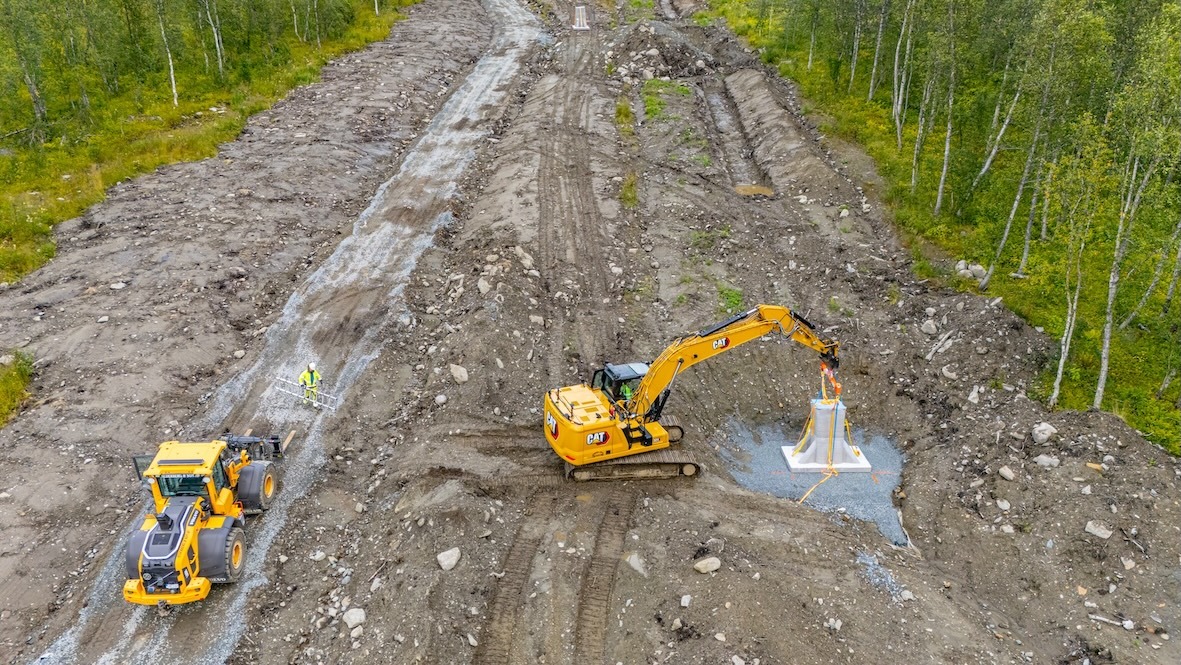
The lift will serve a new 3000 bed ski resort in Northern Sweden.The resort will have four ski lifts and seven ski slopes, and developer Hemavan Alpint is investing SEK 200 million ($20.8 million) in the project, with the current lift costing around $2.6 million in total. Construction underway for the new ski lift in Hemavan, Sweden.Image courtesy of Hyperion Robotics.
Hemavan and skiing there are growing, and the lift is being installed to support that.The new lift should open up a new ski area, giving skiers more room to roam.The lift itself is being made by Leitner Ropeways.
Hyperion will be doing the construction.That company is specifically doing low-carbon construction using 3D printing.Hyperion has received subsidies and contracts tied to its work on lower-carbon construction using additive manufacturing.
Previously, the company made EV charging stations for Fastned, a CO2 pipeline, and foundations for a wastewater site.By focusing on infrastructure in Europe, the company will work with very similar partners and with similar intentions.In every project, civil engineers, infrastructure firms, and government bodies ask the same questions and share the same concerns.
Energy infrastructure in Europe offers a huge opportunity, and becoming a known name in that arena is an excellent strategy.Work on the ski lift foundations in Hemavan, where Hyperion Robotics is using 3D printing for the project.Image courtesy of Hyperion Robotics.
The current ski lift foundation project is for developer Hemavan Alpint, with safety assessor DEKRA.The material usage is said to be 40% less than conventional construction.Ski lifts may seem like a vacation luxury.
But in Colombia and many other places, ski lifts are now being used as cost-effective urban transport.Rapidly growing cities with underserved neighborhoods are growing fast around the world.Lower-income communities are often far off, with people cut off from services and forced to make long commutes.
What’s more, if you have little in the way of money and the center is far off, you’re less likely to enjoy the public parks, museums, and facilities in the center as well.Efficient transport systems like subways are expensive, prohibitively so for many cities.Even cheaper options such as light rail or bus lanes can be very complex to carry out.
Enter ski lifts: a cost-effective, minimally invasive mass-transit system for the urban environment.In terms of construction cost and complexity, ski lifts are very cost-effective.They´re also much easier on cities in terms of road closures and interruptions to traffic flows.
No big dig: a ski lift project is more like robotic surgery on your city than someone cutting open your chest.Now imagine if Hyperion succeeds in cost-effectively establishing local factories in place for every sizable project.Producing locally, close to the site, would make the material-efficient foundation blocks even more efficient to make.
Customized blocks could also address specific ground or urban conditions.Overall construction should be more efficient.Consider a giant city like Mumbai, which already faces traffic challenges.
If there are always traffic jams on the Western Express Highway, a factory could be set up east of the road for all portions east of the Highway.That would significantly shorten construction time.Then the factory could be moved to the other side of the road for the rest of construction.
That kind of flexibility could really shorten times for big projects.At the same time, in some places, the feet wouldn’t have to be imported and could be made locally.And lighter but stronger feet could mean ski lifts could be put in areas where they normally wouldn’t be possible because the ground is too soft, for example.
There are ski lifts with integrated solar as well, and height differences may yet mean that some kind of battery infrastructure could be created as well.Bogotá’s and La Paz’s cable cars already have rooftop solar.If someone found a way to integrate overhead power cables and more solar into the ski lifts’ lines and towers, the infrastructure could do double or triple duty.
But perhaps that would be super dangerous too.Anyhow, this is an exciting development.The economics of this are sure to be stellar.
If this concept is born out here, we may be seeing a lot more 3D printed ski lift infrastructure, and not only in places where you can ski! Subscribe to Our Email Newsletter Stay up-to-date on all the latest news from the 3D printing industry and receive information and offers from third party vendors.Print Services Upload your 3D Models and get them printed quickly and efficiently.Powered by FacFox Powered by 3D Systems Powered by Craftcloud Powered by First Mold Powered by Xometry 3DPrinting Business Directory 3DPrinting Business Directory
Read More