Compact crossovers have basically become the default new car for Americans.They’re easier to live with than larger SUVs, cheaper to run, and now come packed with tech and comfort features that used to feel reserved for pricier vehicles.That’s a big reason affordable Japanese models still dominate this part of the market.
Buyers want something practical and reliable that doesn’t feel stripped down, especially now that even entry-level SUVs can creep past the $30,000 mark.The sweet spot is a crossover that gives you just enough space, solid fuel economy, modern safety tech, and low ownership stress without making your monthly payment painful.Honda’s HR-V fits that formula better than most.
In order to give you the most up-to-date and accurate information possible, the data used to compile this article was sourced from Honda and other authoritative sources, including Edmunds, the EPA, iSeeCars, J.D.Power, and TopSpeed.Related 10 budget-friendly SUVs that rarely need repairs Budget-friendly and dependable: these SUVs won't break the bank.
Posts By Tyler Dupont Why Japanese brands still dominate affordable SUVs Affordable crossovers have become the go-to choice for buyers Japanese automakers figured out the crossover formula before almost anyone else.Back in the 1990s, brands like Honda and Toyota started moving away from bulky truck-based SUVs and toward lighter, car-like models that were easier to drive every day.That change ended up reshaping the entire market.
Buyers loved getting the higher seating position and SUV styling without sacrificing fuel economy, ride comfort, or easy city driving.Fast-forward to today, and Japanese brands still run this segment.Whether it’s reliability, resale value, or overall practicality, they continue to set the benchmark for affordable crossovers in America.
How Honda became one of the biggest crossover success stories Honda played a big role in shaping the affordable compact crossover space, building a range of models that helped define what the segment is today.When it first took off in the late ’90s, Honda helped set the tone with vehicles that felt more like cars to drive but still gave you SUV-style space and height.The appeal was simple: solid fuel economy, easy everyday driving, and the kind of reliability buyers could count on without paying traditional SUV prices.
That mix quickly became the benchmark others had to match.Since then, Honda has kept its lineup growing to stay competitive across different buyer needs.While its smaller models don’t always grab the same attention as the CR-V, they still land in a sweet spot for drivers who want something affordable, practical, and easy to live with.
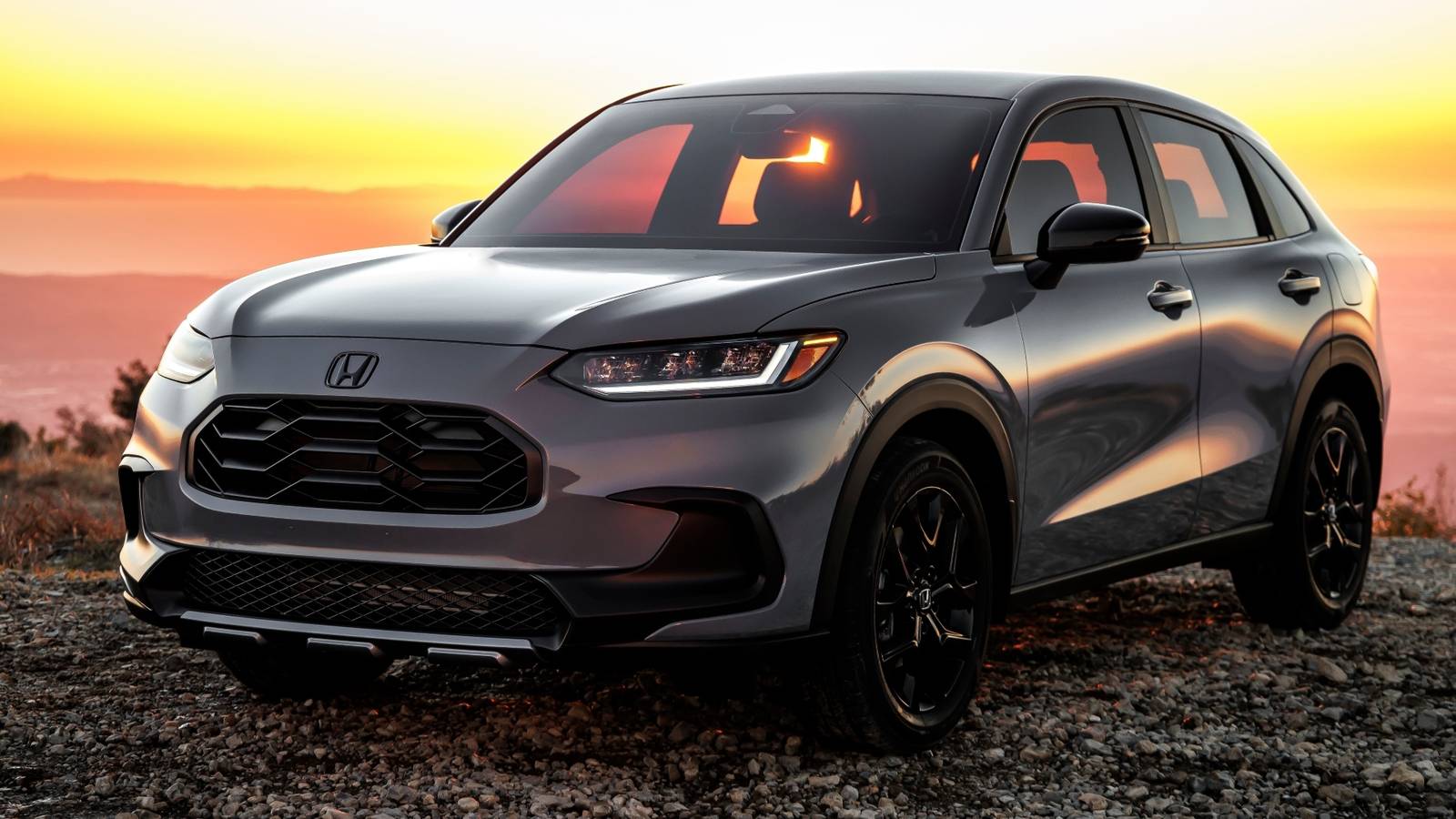
Related How the 2026 Honda Passport quietly beats more expensive rivals The 2026 Honda Passport brings 285 horsepower, upgraded AWD, and rugged looks to take on off-road rivals like the Bronco and Land Cruiser.Posts By Adam Gray Why the HR-V still flies under the radar A closer look at Honda’s entry-level SUV and what it offers for the price The 2027 Honda HR-V sits at the very entry point of Honda’s crossover lineup.It’s the smallest and most affordable SUV the brand sells in the U.S., acting as the gateway into everything above it.
This current-generation model arrived for the 2023 model year as a major reset.It moved onto Honda’s larger, more refined Civic-based platform, trading its old quirky subcompact feel for something more mature and premium.Even in its key spot under the CR-V, the HR-V hasn’t had the smoothest run lately.
Honda’s Q1 2026 U.S.sales showed solid volume, with over 11,000 units in March alone and a 24.2 percent year-on-year drop in first-quarter deliveries, highlighting just how competitive the sub-$30,000 crossover segment has become.Affordable pricing meets everyday features Pricing for the 2027 Honda HR-V keeps it firmly in the entry-level crossover space.
It starts at $28,050 for the base LX trim, making it one of the more accessible ways into a new Honda SUV.Even at that price, you still get a decent list of standard kit.It includes automatic climate control, push-button start, power windows, a 7.0-inch digital instrument cluster, and a 9.0-inch touchscreen with wireless Apple CarPlay and Android Auto, plus a Qi wireless charger, three USB-C ports, and a four-speaker audio system with active noise cancellation.
Stepping up to the mid-tier Sport trim brings the price to $29,850, along with more aggressive styling and extra convenience features.It adds a leather-wrapped steering wheel and shift knob, ambient console lighting, and black cloth seats with orange stitching.Honda also includes remote engine start, Smart Entry with Walk Away Auto Lock, heated front seats, and a six-speaker audio setup.
The range-topping EX-L starts at $31,900 and leans fully into a more upscale feel.It adds leather-trimmed seats, an eight-way power driver’s seat, dual-zone climate control, and a one-touch power sunroof.The EX-L also upgrades the audio system to an eight-speaker, 180-watt setup.
Related 10 Honda SUVs You Should Buy Used These 10 used Honda SUVs offer great reliability, value, and performance for budget-conscious buyers.Posts 2 By Tyler Dupont Surprisingly roomy for its size How Honda squeezes real practicality into a small footprint The HR-V’s cabin is all about making the most of a compact footprint.Honda focuses on passenger comfort and flexible space, and it shows in the way everything is packaged.
Front-seat occupants get 39.4 inches of headroom and 41.9 inches of legroom, while rear passengers still have a respectable 38.0 inches of headroom and 37.7 inches of legroom.Cargo space is just as flexible depending on how you set it up.With the rear seats up, you get 24.4 cubic feet of storage, and folding the 60/40 split rear bench opens that up to 55.1 cubic feet of flat floor space.
Reliability over outright performance The 2027 HR-V sticks with a single engine option, keeping things simple.It uses Honda’s 2.0-liter naturally aspirated, 16-valve DOHC i-VTEC four-cylinder.Output comes in at 158 horsepower at 6,500 rpm and 138 lb-ft of torque at 4,200 rpm.
Power is sent to the front wheels through a CVT with Honda’s G-Design shift mapping.Honda HR-V Like SUV 2027 Base: $26,600 Base Trim Engine 2L I4 ICE Base Trim Transmission CVT Base Trim Drivetrain Front-Wheel Drive Base Trim Horsepower 158 HP @6500 RPM Base Trim Torque 138 lb.-ft.@ 4200 RPM Base Trim Fuel Economy (city/highway/combined) 26/32/28 MPG Make Honda Model HR-V Segment Subcompact SUV Powered by Expand Collapse Honda tunes the CVT to mimic traditional gear shifts, helping reduce the rubber-band feel that older units were known for.
It makes the HR-V feel more natural in everyday driving, even if it’s not built for performance.All-wheel drive is available across the range for an extra $1,500, depending on trim.Acceleration is modest, with a 0–60 mph time of 9.4 seconds and a top speed limited to 116 mph.
It’s worth noting that the HR-V isn’t rated for towing.Related Honda Adds Rugged Capability to Its Best‑Selling SUV for 2026 For 2026, Honda’s best-selling SUV gets a tougher edge with more off-road capability, Trailsport styling, and improved versatility.Posts By Tyler Dupont Well-suited fuel economy for city driving Efficiency-focused running costs that make daily life easier When it comes to efficiency, the front-wheel-drive HR-V returns an -estimated 26/32/28 mpg across city, highway, and combined cycles.
Switching to all-wheel drive barely moves the needle, dropping slightly to 25/30/27 mpg.Both versions use a 14.0-gallon fuel tank, which translates to about 392 miles of range for FWD and 378 miles for AWD.It’s the kind of real-world efficiency that keeps day-to-day running costs low without much compromise.
Based on estimates of 15,000 miles per year and current fuel prices, the FWD model comes in at roughly $1,600 annually in fuel costs.That works out to around $2.64 per 25 miles and about $44 to fill the tank, though it still ends up costing roughly $500 more in fuel over five years than the average new vehicle.What owners like about it most The section gives the 2026 HR-V a 4.2/5 average score.
Owners tend to highlight interior space, easy driving manners, and overall value as its biggest strengths.That said, it’s not without criticism, with some pointing to uncomfortable seats, noticeable road noise, and cheaper-feeling materials in lower trims.According to , the 2026 model scores 82/100 overall, with strong marks for quality and reliability at 83/100 and resale at 86/100.
It also rates 75/100 for driving experience and 83/100 for dealership experience.estimates an average lifespan of 17.8 years or about 195,524 miles, with a 48.1 percent chance of reaching 200,000 miles.It’s also projected to lose $7,601 or 28.7 percent in value after five years.
Read More