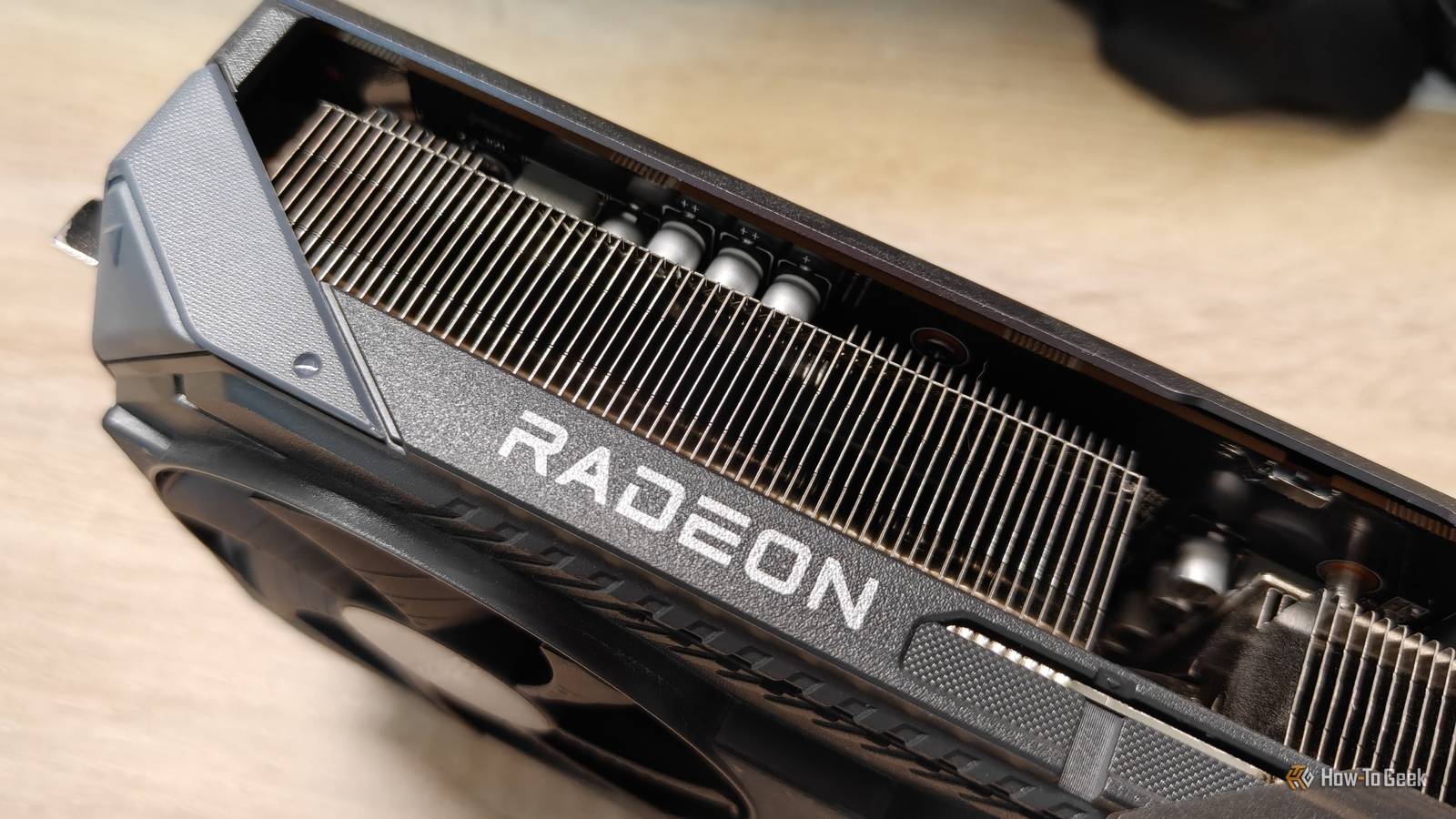
NVIDIA has built a phenomenal software ecosystem around its consumer graphics cards, with DLSS often at the heart of the argument for buying a GeForce GPU.While DLSS's feature set is undeniably the best that exists right now, it just doesn't make up for the exorbitant prices that NVIDIA's graphics cards are going for.Many gamers are choosing NVIDIA specifically to get DLSS, but the truth is that you could get a substantially more powerful graphics card with much more raw rendering performance and often more VRAM if you just went with AMD instead.
NVIDIA's GPU premium has become the norm Paying for the badge Close NVIDIA has been the more expensive alternative to AMD (and, more recently, Intel) for as long as I can remember.When I was growing up in the 2000s, people would laugh at you for having an ATI Radeon card, and, truthfully, NVIDIA was often the better choice.I remember not even being able to play the original because my particular Radeon card lacked Shader Model 3.0 support, while NVIDIA cards of the time worked just fine.
A lot has changed since then, but NVIDIA has held onto that reputation.In fact, it has cemented itself firmly as the market leader in GPUs and consistently prices GeForce cards at a premium.If the reported 90% share of the discrete graphics card market and NVIDIA's dominance in the Steam Hardware Survey are anything to go by, people are clearly willing to pay that premium for NVIDIA's software ecosystem.
Whether it's better-optimized ray tracing hardware, CUDA for running local AI, or the robust, ever-growing DLSS feature stack, people have voted with their wallets and decided these features are worth paying more for.Nvidia GPU prices have gone through the roof You get less for more We're well past MSRP pricing at this point in the release cycle of the RTX 5000 Series and AMD RX 9000 Series.The NVIDIA RTX 5070 Ti's $749 MSRP made perfect sense against the AMD RX 9070 XT's $599 MSRP, as the NVIDIA card is slightly faster and has a substantial advantage when ray tracing and DLSS enter the equation.
But because of the current RAM shortage and unprecedented demand for graphics cards, the RTX 5070 Ti doesn't cost $749 anymore — it costs around $1,150, and that's the cheapest one I could find.The RX 9070 XT has gone up quite a bit in price too, but nowhere near as much.It's around $800, meaning the original $150 price gap between the two models has more than doubled to $350.
The cards perform similarly in many games when upscaling isn't enabled, so I'm not sure that extra $350 is worth it for most people.You could buy a pretty decent CPU and maybe even a motherboard for your $350.It's the same story with every other NVIDIA card: RTX 5090: around $6,900, compared to a $1,999 MSRP.
RTX 5080: around $1,580, compared to a $999 MSRP.RTX 5070: around $870, compared to a $549 MSRP.RTX 5060 Ti 16GB: around $780, compared to a $429 MSRP.
RTX 5060 Ti: around $510, compared to a $379 MSRP.RTX 5060: around $460, compared to a $299 MSRP.DLSS can't make up for Nvidia's weaker raw performance Generated frames cost you more than you realize NVIDIA's price premium was a much easier pill to swallow at MSRP prices, but they've gone up so much that, no matter which card you're looking to get, there's a very good chance you could buy a higher-tier AMD card and even save some money to put toward the rest of your build.
Instead of the NVIDIA RTX 5060 or 8GB 5060 Ti, you could buy the AMD RX 9060 XT 8GB for just $450, though the $520 RX 9060 XT 16GB is a much better buy overall.Things get so much worse from here, though.The NVIDIA RTX 5060 Ti 16GB is one of the worst-value cards of all time, as its current market price puts it in the same tier as the AMD RX 9070 XT, a card that's 60–70% faster in games at 1440p and 4K.
It has drastically better ray tracing performance too, which is an area where NVIDIA typically leads.You can't tell me that DLSS makes the NVIDIA card worth picking here (well, unless you're a diehard fan of AI slop).It's undeniably better than AMD's FSR, but "fake frames" can still produce the occasional visual artifact or blurry visuals, and the NVIDIA card just can't make up for that massive gap in raw GPU performance.
Besides, frame generation works best with a strong base frame rate.A 60 FPS game with generated frames won't suddenly feel like native 120 FPS, while the AMD card could be rendering close to 100 FPS on its own.Even though FSR Frame Generation still has some frame-pacing issues, they're much less noticeable when the game is already running at a high frame rate.
I personally use FSR upscaling and frame generation on my RX 9070 XT whenever they're available, and I've been very happy with the performance.Nvidia cards just don't make sense for most gamers at today's prices Unless you mess with local AI and absolutely need CUDA, NVIDIA cards just don't make much sense at current retail prices (and it's not like AMD's ROCm is far behind anyway).What used to be “maybe get AMD if you're on a tight budget” advice that I usually dished out has now turned into “definitely buy AMD.” Well, that's unless you have money to burn and are in the market for an RTX 5090.
Related After Using NVIDIA for a Decade, I Just Bought an AMD GPU After a decade, I'm switching back to Team Red.Posts 7 By Goran Damnjanovic
Read More