The Cooperative Research and Development Agreement (CRADA) model for establishing private-public partnerships has started to gain traction in the additive manufacturing (AM) industry over the last couple of years.In a recent example, 3D Systems and Savannah River National Laboratory (SRNL) announced a CRADA surrounding AM for nuclear applications.CRADAs enable the government and companies to share resources, IP, staff, etc., and provide an opportunity for the companies involved to file patents based on the results of the R&D work.
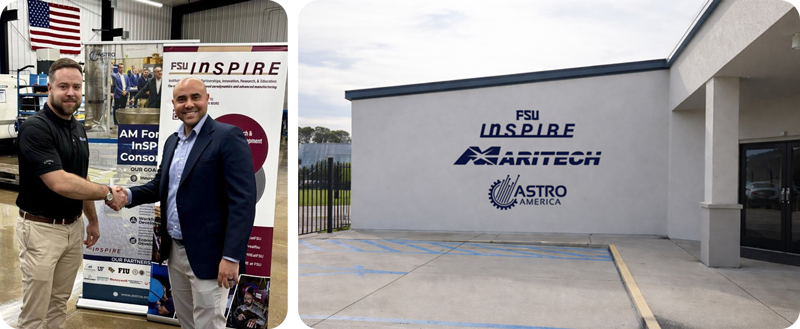
Now, Applied Science and Technology Organization (ASTRO) America, the nonprofit primarily responsible for managing the activities associated with the AM Forward compact, has established a CRADA with the Air Force Research Lab (AFRL), backed with nearly $9 million in joint investments.Northrop Grumman and Florida State University (FSU) InSPIRE, a key ASTRO America partner, will also participate in the program, which aims to accelerate commercialization of Northrop Grumman’s Gray Wolf missile design.The CRADA will serve to stand up an initiative ASTRO calls DART: Design for Affordable and Rapid Throughput.
The partners will benefit from being able to leverage a new manufacturing R&D site located near Eglin Air Force Base (AFB), in northwest Florida.Eglin AFB is also where the Gray Wolf design has been developed over a period of nearly a decade, as part of an Air Force program specifically aiming to lower the cost of missile production.In addition to developing solutions that are directly applicable to Gray Wolf, the CRADA may also influence the technical direction of future relevant R&D projects.
The DART initiative encompasses multiple different AM processes, as well as the pertinent techniques from other areas of manufacturing, including casting and machining.I just wrote about how solid rocket motors (SRMs) are the first big scaling challenge for AM in the US defense sector and, while the Gray Wolf doesn’t use SRMs, the DART initiative nonetheless aligns with precisely the same goals involved in scaling SRM production, albeit with a focus on different production techniques.Gray Wolf itself didn’t originate as part of the Family of Affordable Mass Munitions (FAMM) program, but it fits that same mold, one which, in turn, fits within a broader category of commercialization acceleration activities that the various US military branches are pushing for.
Moreover, along with CRADAs and low-cost munitions, the DART initiative reflects yet another theme I’ve been writing more about: the advantages of incorporating research universities into corporate R&D programs.Obviously, given all its work with FSU InSPIRE, as well as the work ASTRO is doing in with various partners in Guam, this is familiar territory for ASTRO.InSPIRE in particular is fascinating because it originated in large part thanks to a nearly $100 million grant from Triumph Gulf Coast, which manages funds recovered from settlements related to the Deepwater Horizon disaster in 2010.
I don’t know what it was that led to a portion of those funds being used for this purpose, but it’s an idea that seems like it should be implemented more often.It doesn’t even require a catastrophic event to happen in order for it to work! For instance, there’s lots of talk about tech giants paying some sort of social tax for all the destruction they intend to wreak with AI, with much of that talk revolving around the idea of giving the average taxpayer a share in companies subsidized by the government.A more sensible idea would be for tech giants, etc.
to invest in programs like FSU InSPIRE, which would have the added bonus of creating the jobs required to execute the AI buildout.We also already have evidence that this kind of program can work.Workforce development in the US is an absolute mess, and there appears to be no chance of that changing without outside-the-box thinking.
The advantage of expanding what ASTRO is doing with FSU InSPIRE is that it wouldn’t even have to be that “outside-the-box”: just give more money to the organizations already doing the thing that needs to get done.Images courtesy of ASTRO America Subscribe to Our Email Newsletter Stay up-to-date on all the latest news from the 3D printing industry and receive information and offers from third party vendors.Print Services Upload your 3D Models and get them printed quickly and efficiently.
Powered by FacFox Powered by 3D Systems Powered by Craftcloud Powered by First Mold Powered by Xometry 3DPrinting Business Directory 3DPrinting Business Directory
Read More