We’re starting with post-processing news in today’s 3D Printing News Briefs, as AM Solutions shares the latest results from the AutoSmooth Project.CONSTRUCT3D launched a new 3D printer, while 3DXTECH has a new addition to its 3DXLabs program.Moving on to research, a Missouri S&T team is using light-based 3D-printing to speed up making organs-on-a-chip, and researchers from EAH Jena and University of Jena are working on biocompatible micro-optics for endoscopes.
AM Solutions Shares Latest Results from AutoSmooth Project for CMF Parts From the green part to the finished surface: AutoSmooth automates the entire post-processing workflow in the ColdMetalFusion process, including depowdering, smoothing and full feedstock reuse — as a fully integrated 3-in-1 process.Two years ago, AM Solutions (a Rösler company) partnered with Headmade Materials and Neue Materialien Bayreuth (NMB) for the AutoSmooth project to help advance ColdMetalFusion (CMF) technology, which enables serial production of high-quality metal components.The project forms the foundation for a fully automated post-processing system from AM Solutions, and the goal is to create an efficient, fully automated post-printing process for CMF parts.
The first results of the project—a new depowdering and surface finishing technology for green parts—helped to majorly reduce post-processing time.Now, the project partners have shared the latest: automated feedstock reuse.They’ve found that feedstock processed through AutoSmooth should be 100% recyclable, which could help reduce material costs, as well as CO₂ footprints.
NMB is examining how reused materials could affect long-term part performance, and a comprehensive life-cycle analysis should be done by mid-2026.The project partners are also working on how to handle complex green parts, which have very delicate structures that could get damaged in a traditional rotating blasting basket.“Interest in CMF continues to rise – against the general trend in the additive industry.
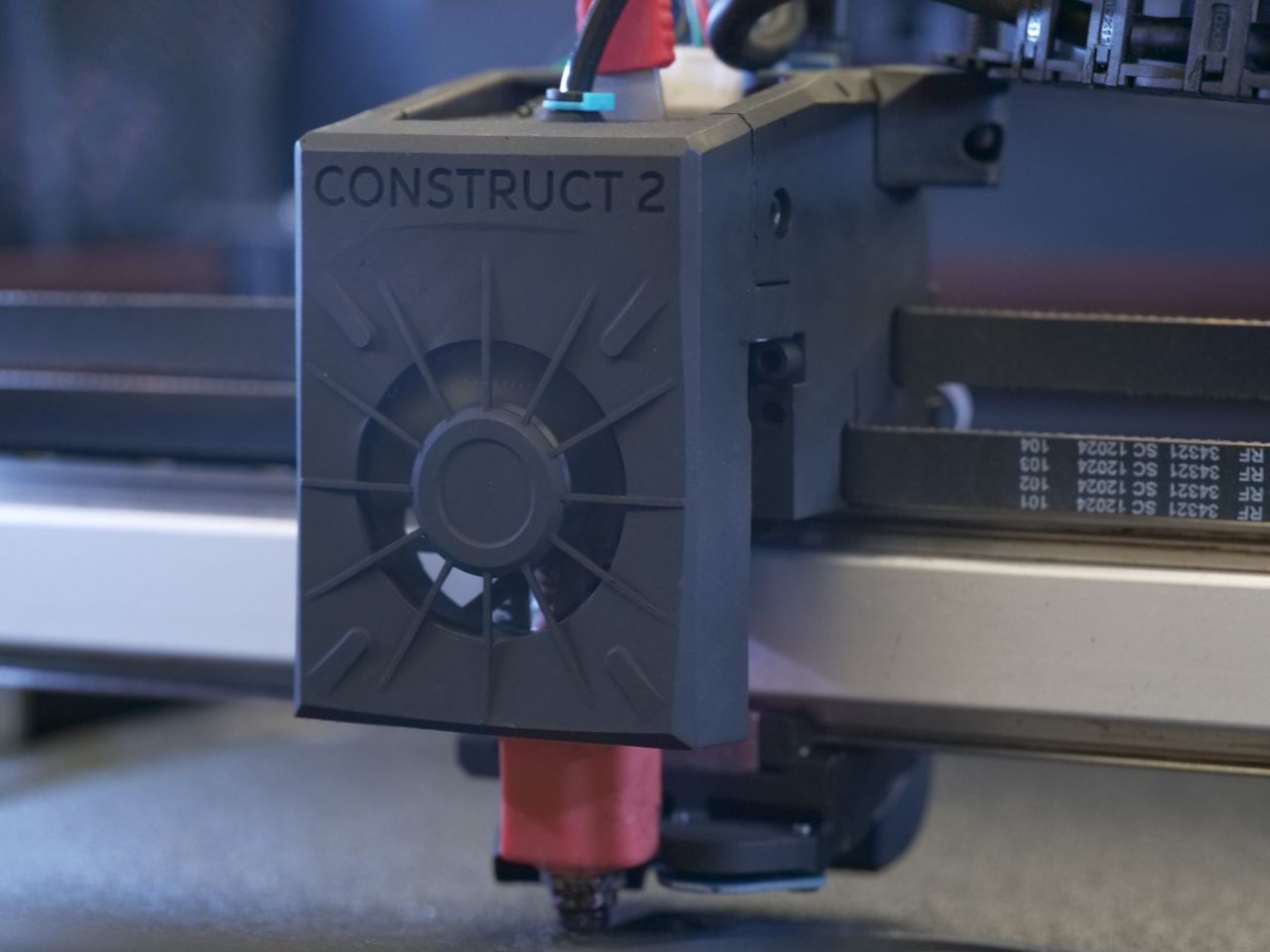
That’s because CMF makes metal printing economically viable, particularly in prototyping and serial production,” said AutoSmooth project lead Sven Amon, a project engineer at Rösler.“With the new AutoSmooth post-processing method, the process can now reach its full potential.” CONSTRUCT3D Unveils Next-Generation Construct 2 3D Printer Images courtesy of University of Warwick via LinkedIn.At the UK’s Advanced Engineering Show in October, CONSTRUCT3D unveiled its latest 3D printer.
The next-generation Construct 2 was launched to the public at the AM Futures stand, which was also showcasing solutions from Caracol, 3ntr, Eplus3D, and others.Described as a “true production workhorse,” the printer was developed for industrial-scale and ultra high-speed printing, and designed to operate continuously 24/7.With a 340 x 390 x 400 mm build volume, it’s definitely larger than its predecessors, the Construct 1 and Construct 1XL, and is said to be able to achieve up to 8 kg of material throughput a day.
The high-performance Construct 2 also features intelligent process monitoring, precision control systems, 500 mm/s print speed, full data security, auto-calibration, an active heated chamber, a quick-swapping hotend, and can support advanced engineering polymers.“The Construct 2 isn’t just an upgrade—it’s a turning point.It sets a new benchmark for what’s possible in industrial 3D printing, unlocking new levels of production scale without compromising quality or speed,” said Jacob Lord, CTO at CONSTRUCT3D.
There will be a keynote launch for the Construct 2 at University of Warwick on December 16th.You can pre-order the new Construct 2 3D printer here.3DXTECH Expands 3DXLabs Program with FR-PC Material In June of 2025, high-performance 3D printing materials manufacturer 3DXTECH launched its 3DXLabs program, which gives customers early access to its experimental, R&D-grade materials still under development.
The community-driven program asks participants to share real-world feedback about the materials, which is then used to shape products’ performance and capabilities.3DXLabs is now expanding the program with the release of its new FR-PC material for demanding automotive and electrical applications.This advanced flame-retardant polycarbonate was created within the collaborative 3DXLabs ecosystem, formatted for the highest ratings in flame retardancy and IEC60112 Comparative Tracking Index (CTI) standards.
FR-PC offers an IEC60112 CTI rating of 600V, and a UL94 V-0 burn rating at 1.5 mm, along with excellent electrical insulation properties, consistent mechanical behavior across a range of temperatures, and great dimensional stability.All of these properties combined make it a great material for electric vehicle (EV) systems, connectors, and components for mobility and power systems.“We saw an opportunity in our portfolio to build from our FR-PC-ABS and create something more sustainable in the EV market, especially as additive manufacturing continues to expand as a key solution in that industry.
Through the 3DXLabs platform, we have been able to fast-track materials like FR-PC by validating real-world needs directly with the engineers who rely on them,” said Rachel Rogers, Product Manager at 3DXTECH.Missouri S&T Researchers Develop Light-Based 3D Printing for Organs-on-a-Chip Dr.Anthony Convertine prepares a liquid resin for 3D printing biomaterials used for tissue engineering.
Photo by Michael Pierce/Missouri S&T Organs-on-a-chip are small, tissue-like devices that help scientists see how human tissues respond to new treatments or medicine, without having to test them on animal or human subjects.A team of researchers from Missouri Science and Technology (S&T) developed a new light-based 3D printing method that could simplify and speed up the process of making these.According to Dr.
Anthony Convertine, an associate professor of materials science and engineering, there are about 37 trillion cells in the human body, and almost all of them need to be close to a capillary in order to survive, which makes re-creating them “a major engineering challenge for tissue engineering.” He said the typical way to 3D print tissue is similar to an inkjet printer plotting dots on a page, which is pretty inefficient.This team’s method uses a light-curable, self-assembling resin that builds sacrificial structures, which are later dissolved—leaving behind clean microchannels.Their research was the cover article on a recent issue of Biomaterials Science, which makes it the third time since 2023 that S&T researchers have been featured on the cover of a Royal Society of Chemistry publication for their tissue engineering work.
“It is incredibly gratifying to see these three related papers, each building on the last, reach this level of visibility.It shows how far our work has progressed and signals even larger advances ahead for 3D-printed materials in tissue engineering,” said Dr.Convertine.
5D Printing Biocompatible Micro-Optics for Endoscopes Additively manufactured apple with a complex gyroid structure to demonstrate the extended possibilities of 5D printing.Image: Jens Bliedtner Researchers from University of Applied Sciences (EAH) Jena and Friedrich Schiller University Jena are launching a joint research project, called “ADAM—Adaptive Dynamic and Biocompatible Microoptics for Endoscopy Systems using 5D Printing,” supported by the Carl-Zeiss-Stiftung foundation.Micro-optics can achieve high-resolution imaging in minimally invasive procedures, and the team is working to develop ones that can adapt their spectral properties and focal position in real time to changing conditions.
This is the 5D printing aspect: shape is 3D, while “temporal changeability” is 4D, and 5D is designing material properties that react to temperature or light.The research team is creating new functional materials for additive microstructure printing that react to heat or light stimuli—in this case two laser beams of different wavelengths—and respond by actively changing their shape or optical behavior.The goal of the ADAM project is to develop compact, light-controlled micro-optics for microsurgery and endoscopy systems, so they also need to be biocompatible.
“With ADAM, we have the opportunity to redefine the boundaries of medical technology and create pioneering applications by combining biocompatibility and adaptive optics.Our technological approach enables significant progress for 3D printing and for applications in medical technology.At the same time, it strengthens the innovative power of the Thuringia region,” said Prof.
Dr Felix Schacher from the University of Jena.The project will receive about €895,000 in funding for the period between March 2026 to February 2028.Subscribe to Our Email Newsletter Stay up-to-date on all the latest news from the 3D printing industry and receive information and offers from third party vendors.
Print Services
Upload your 3D Models and get them printed quickly and efficiently.Powered by FacFox
Powered by 3D Systems
Powered by Craftcloud
Powered by Xometry
3DPrinting Business Directory
3DPrinting Business Directory