I've always found resume writing to be a headache, and it's only gotten worse.There are ATS (Applicant Tracking System) tools scanning for keywords, design conventions I'm no longer up to date on, endless advice about mirroring the language of the job posting—and who knows what else.It's a lot to keep track of for a document I neither enjoy writing nor have much experience creating.
I also don't have much incentive to get better at it, since I land most jobs through social outreach or referrals.So I wanted to hand the work over to AI—eyeing two key benefits.The first is that these AI chatbots already know a lot about me.
I use Claude for most of my personal work, ChatGPT for vibe coding, and while I don't use Gemini as often, it comes bundled with my Google storage plan and has access to my Gmail, Google Docs, Calendar, and Keep notes.In theory, I could show any of them the job I was applying for, and they should be able to connect the dots between my experience and the job requirements to build the perfect resume.The second was the idea that AI could produce a better resume than I would on my own.
Normally, I'd open Microsoft Word or Google Docs and create something basic and generic.But with AI, I could have it build the resume as a polished, portfolio-style webpage and then simply save that HTML page as a PDF.That was the end goal: to see which AI could present me in the most polished, hire-worthy way.
Claude did an okay job It felt very average—something recruiters would likely gloss over Close I started by pasting the job posting into Claude, selecting Opus 5 as my preferred model, and asking it to build me a resume, with one addition to the prompt: before writing anything, ask me at least 20 questions to clear up whatever it needed to know.It came back with 23 questions, neatly categorized into strategy and targeting, credentials and track record, education and background, positioning, and practical details like my LinkedIn URL and email.I answered them using a voice-to-text tool and let it get to work.
The first draft didn't impress me.It was plain white, with all the information densely packed into chunky blocks of text.Claude did do something none of the others did, though.
It dug through my How-To Geek catalog and cited my article count in the resume.Granted, the numbers were wrong—it said 338 articles when my actual count is much higher.Whether it hallucinated or simply didn't research thoroughly enough, I don't know, but I'd have had to correct it manually either way.
It also made an interesting judgment call.It figured out that How-To Geek is part of Valnet and positioned me as someone "already inside the network," presumably as a way to get my foot in the door.I honestly can't tell whether that's a smart move or an overstep, so I left it in.
The bigger issue was readability.Even I didn't want to read the resume, and it's about me.So I asked Claude to make it more visually appealing—something you'd expect from a tech magazine.
It responded with a textbook case of malicious compliance, giving me a resume complete with an "Issue No." header and a section titled "In This Issue," as if it were designing an actual magazine.The concept was clever, but the execution wasn't.I doubted recruiters would understand what it was going for, so I asked Claude to remove those elements.
I kept the rest of the design, though, because it felt like an improvement over the original.Related Claude can now bring your design dreams to life Adobe and Canva have their own options.Posts By Jon Fingas ChatGPT's take felt a bit too busy It was trying to cram in a lot of information Close With ChatGPT, I used the exact same prompt with the GPT-5.6 Terra model.
It asked me 30 questions in total—there was no categorization this time, just a straight list—and there was plenty of overlap with what Claude had asked.I gave it my answers, and it generated a resume that felt—well, still not right.To its credit, ChatGPT didn't fabricate anything, and it didn't attempt the kind of judgment call Claude made with the Valnet connection.
Maybe it researched less thoroughly, or maybe it simply took a more conservative approach.Either way, I actually preferred the scope of what it included.The content felt less opinionated and more grounded than Claude's.
However, the presentation felt a bit too busy.If you've ever seen a Japanese magazine layout, that's the vibe: a lot of things happening at once.Someone who wants maximum information density might love it, but I couldn't see it working for a recruiter skimming through a stack of resumes.
So I asked for a more minimal, streamlined version, and it delivered—but then it swung too far in the opposite direction and felt almost too minimal.Homing in on the right balance was proving to be a chore, and somewhere in the back-and-forth I caught myself thinking it would have been easier to make the resume myself.That's not a great sign for a workflow that's supposed to save time, so I decided to stick with the version I had and move on.
Related You're using Claude wrong if you're treating it like ChatGPT Many people are fleeing ChatGPT for Claude but making the same mistakes.Posts 4 By Dibakar Ghosh I liked Gemini's best But will recruiters agree? Close Then came Gemini, and I wasn't expecting this at all: it gave me the best-looking result of the three.Now, I've vibe coded with Gemini before and never gotten results this good, so my expectations were low going in.
For this test, I used Gemini 3.1 Pro—the best model Google currently offers, though generally considered a step behind ChatGPT's Terra models and Claude Opus—and gave it the same prompt as the other two.It asked me exactly 20 questions and, like Claude, grouped them into categories: writing and leadership experience, technical tinkering, education and career background, contact and personal branding, and design preferences, including two questions about how I wanted the resume itself to look.The one hiccup was the workflow.
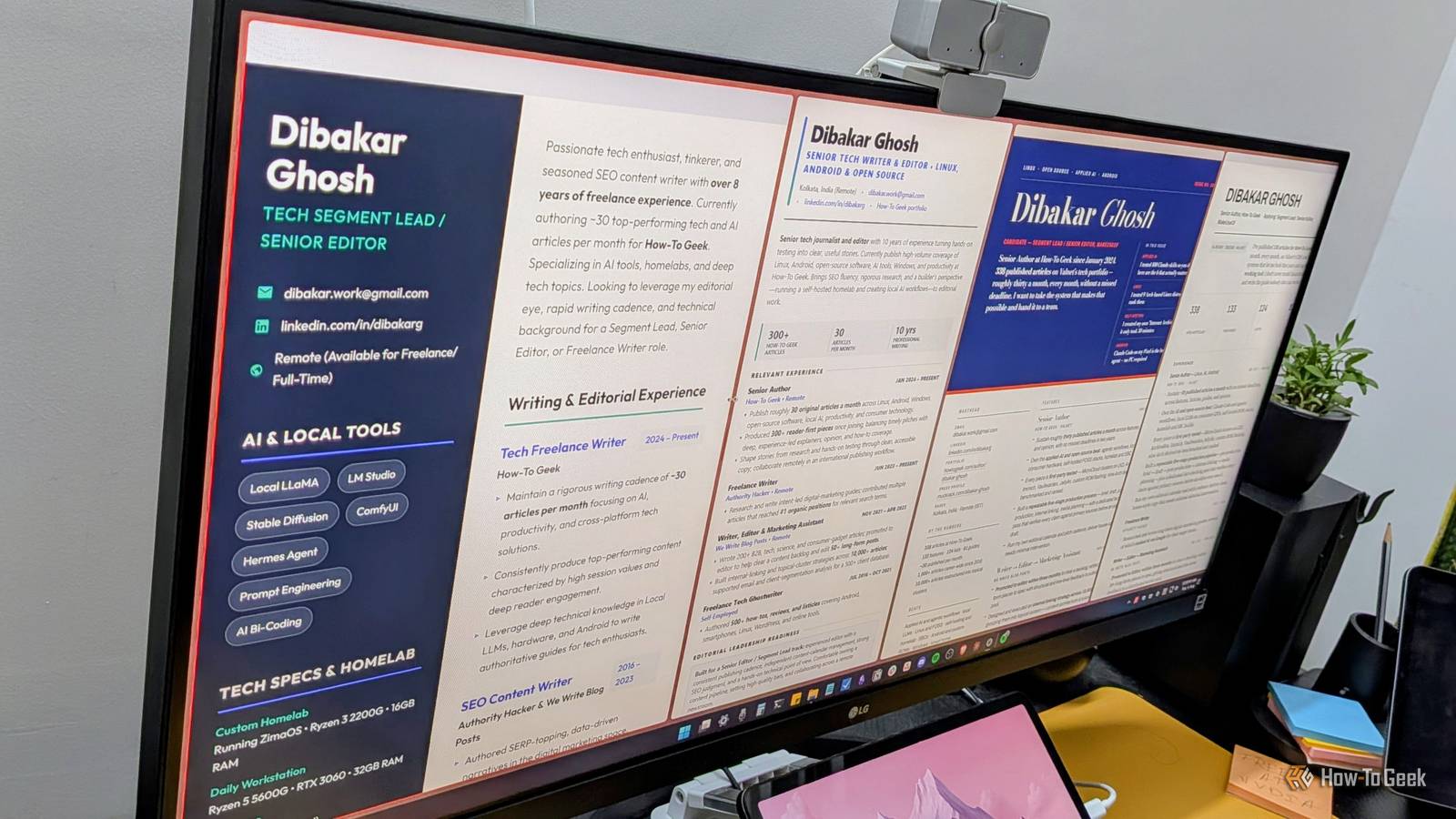
The HTML file Gemini produced wouldn't render inside the app—not in the web app or in Antigravity, the first-party desktop application from Google.As such, to preview the design, I had to copy the code and save it as an HTML file.Coming to the result, it was the closest to what I'd envisioned from the start: a two-column layout with one dark panel and one light panel, strong typography, a header paragraph that communicated the key message, and everything else streamlined and easy to scan.
It looked genuinely professional.If I were a recruiter and this landed on my desk, I'd assume the candidate knew what they were doing and had made an effort to present the information clearly while respecting my time.By my judgment, this was the best resume by far.
But my judgment isn't the one that matters here.Related Claude vs.Gemini: Which one actually writes better code? Gemini has a lot of promise, but Claude wins hands down.
Posts 10 By Patrick Campanale Here's what our recruiter had to say No wonder I rarely crack job interviews—my intuition was completely off Close The resumes in the above gallery are ranked from best to worst as per our recruiter.With everything ready, I had five resumes in hand: two from Claude (labeled Resume 1 and 2), two from ChatGPT (Resume 3 and 4), and one from Gemini (Resume 5).I deliberately stripped the AI names before handing them over—if our recruiter had a bias toward a particular tool, I didn't want it influencing their judgment.
They only received the rendered PDFs—no code, no context.Now, their verdict proves that I really have no idea what makes a good resume.The Gemini resume—the one I was convinced was the winner—ranked dead last.
They thought it felt too busy and that the formatting was overwhelming relative to the level of experience it presented.The two Claude resumes tied for the middle of the pack—not better, not worse, just average.Second place went to the minimal ChatGPT version I'd requested.
And the best resume of the lot was the one ChatGPT produced on its very first try—the "too busy" one I almost didn't take seriously.In hindsight, it makes sense.It delivers a lot of detail at a glance, and apparently that's exactly what recruiters want.
It was also the only one-page resume of the five.The important details were well emphasized, and the formatting was clean.I agree with all of that.
My only complaint was that it felt noisy, with a lot of information competing for attention at once—but it turns out recruiters are perfectly fine with that.Resumes are not yet ready for full AI automation So, the winner was ChatGPT—but it's worth being clear about what actually won.The only reason this particular workflow worked is because I built in a questionnaire step to provide the LLM with useful information.
This allowed it to fill out the resume with accurate and relevant details.I wouldn't confidentially paste a job posting into an LLM, and use whatever resume it generates.It's not at that level yet.
It still requires oversight because only you know your own numbers, dates, and accomplishments.
Read More