ESP32 boards are cheap and versatile, making them highly popular in the maker community.Setting them up isn't always that simple, but there's a tiny OS you can run on an ESP32 that allows you to use one as if it were a very small PC.An operating system you can run on an ESP32 A microcontroller you can use like a real PC Usually when you're building something with an ESP32, you flash dedicated firmware to the device that does one specific job.
Tactility is a completely different approach.It's a tiny operating system designed to run on the ESP32 microcontroller family.Tactility supports a wide range of ESP32 devices, with the recommended models including the LilyGO T-Deck Plus, the Elecrow CrowPanel Advance 2.8", the M5Stack Tab 5, M5Stack Cardputer and Cardputer Adv models, and the Cheap Yellow Display 2432S032C.
Tactility has a graphical interface, and as the name suggests, it's primarily intended to be used via a touchscreen.Once installed on an ESP32 connected to a screen, you can navigate the OS just as you would with a typical PC operating system.Related My internet went down for hours before I noticed—so I built an internet status light with an ESP32 I know when my internet is on the blink.
Posts 2 By Adam Davidson Getting it running was (almost) plug and play There were a few issues during setup I decided to try to run Tactility on my Cheap Yellow Display, a CYD 2432S028R.While this isn't one of the recommended devices, it is listed as supported, although it lacks the external RAM of some other devices.Installation and setup should be fairly simple, but I did hit a couple of bumps in the road.
The simplest method is to use the web installer and connect your ESP32 device to the same computer.You can use the web installer to erase the current firmware and install Tactility.My first issue was that there are three different build options for the various CYD 2432S028R models, and I chose the wrong one on my first try.
When the installation process finished, the CYD just displayed a green screen.I tried again with a different build, and the OS was up and running in under two minutes.The second issue was working through the initial setup screens.
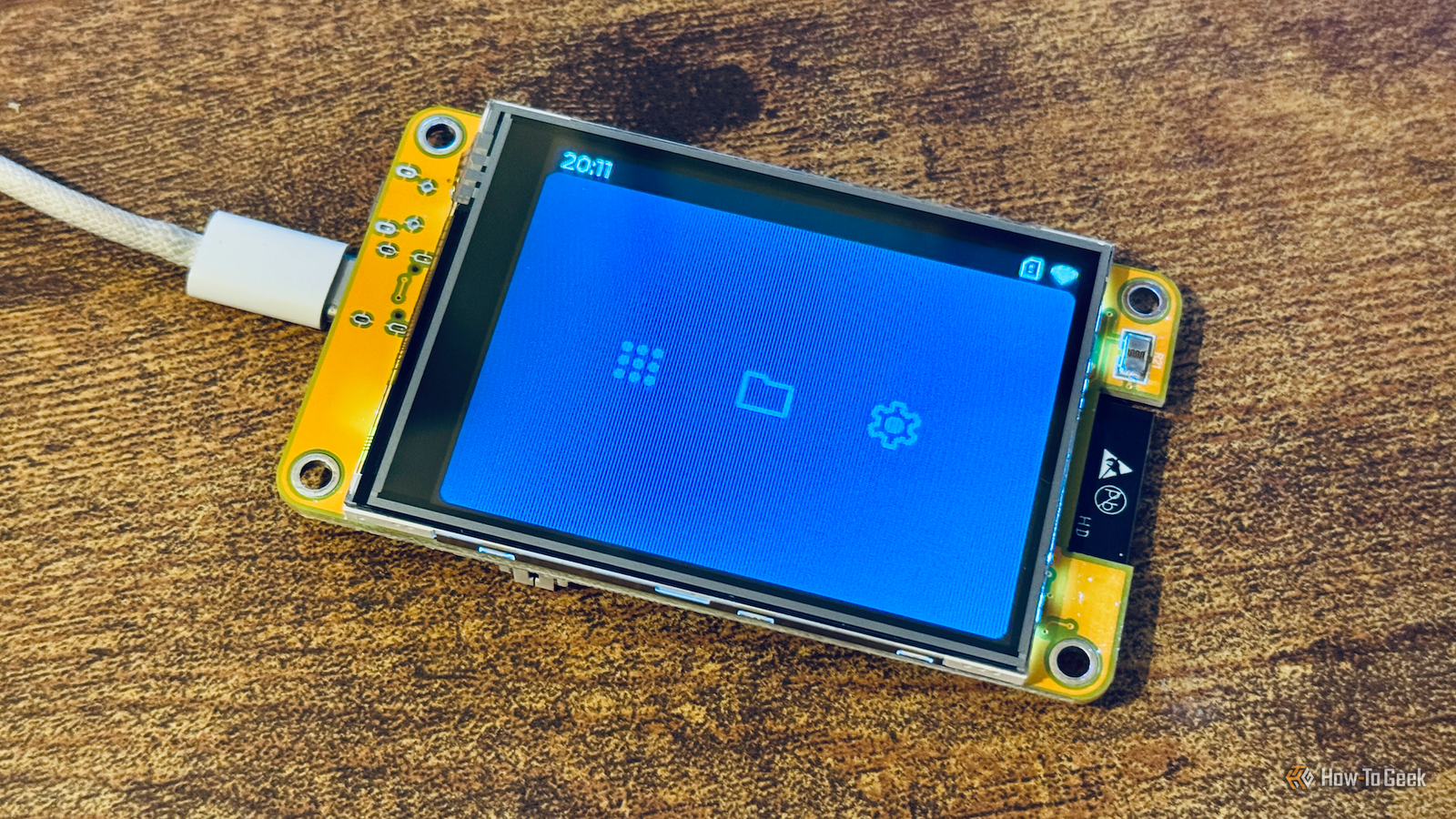
The OS requires a Wi-Fi connection to download additional apps, and I couldn't get it to connect to my Wi-Fi.The issue was that my CYD only supports 2.4 GHz, so I used a different SSID that operates solely at 2.4 GHz, and the Wi-Fi connected without any problems.You get a basic OS that can run small apps There are some fun apps and some useful apps Close Once I'd completed the setup, I was greeted with three simple icons.
There's an app icon, a folder icon, and a settings icon.The file icon opens a file browser that lets you browse the internal or microSD card storage.The settings icon gives access to settings such as the display settings, Wi-Fi settings, and language settings.
Tapping the apps icon brings up the list of preinstalled apps.These include the App Hub app (an app store for Tactility), a chat app for chatting with other local Tactility devices, an I2C scanner, a notes app, and a web server app.Using the App Hub, you can search for and download additional apps.
The installed apps are mostly utilities, but you can install some fun apps via the App Hub.You can install a version of the 2048 number puzzle game, a Tamagotchi-like game, and even an EPUB reader.You can also develop and run your own apps in Tactility.
Unsurprisingly, the OS is still very limited Without PSRAM, there's a lot you can't run Before you start unplugging your mini PC to throw it in the trash, you should be aware of the limitations.Unsurprisingly for an OS running on an ESP32, the apps that you can run are extremely limited.I wasn't able to run some of the apps from the App Hub because my CYD lacks PSRAM.
Some ESP32 boards have additional RAM in the form of PSRAM that provides additional memory beyond the internal RAM of the ESP32 itself.Without PSRAM, my CYD can't run the EPUB reader app, which is a shame as I've become a little bit obsessed with tiny eReaders since getting one of my own.It means that I'm limited to what I can do with Tactility on my CYD, although some of the larger CYD variants do have PSRAM.
I'm not going to be using Tactility on my CYD for any projects in the near future, as the limited resources of the device are better suited to dedicated firmware.Even so, it's impressive to see a genuine OS running on an ESP32.You can do a lot with an ESP32 Some people are put off experimenting with ESP32 boards because they assume you need to write complex code or get busy with a soldering iron to do anything useful with them.
Tactility proves you can get an ESP32 running real apps with nothing but a USB cable and a browser.
Read More