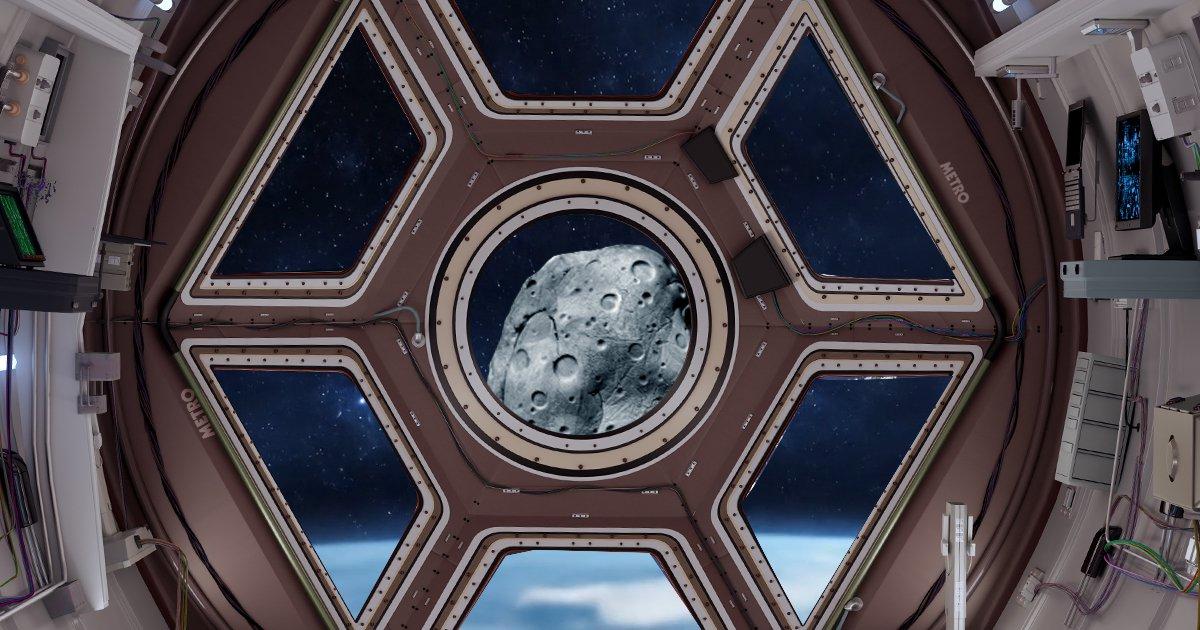
Scientists want to use a solar slingshot to catch up with the interstellar visitor 3I/ATLAS, that thing that may-or-may-not have been a UFO.In the months since 3I/ATLAS was spotted drifting into our solar system, experts clashed over whether it was a comet or of extraterrestrial origin.One reason for this was that even at its closest to Earth in December, 3I/ATLAS was still 167 million miles away, making observations tricky.
A team from the Initiative for Interstellar Studies said we could launch a 500kg probe into space that would use the sun’s gravity like a catapult to catch up with 3I/ATLAS.But while it’s curving around our star, it would exploit the ‘Oberth effect’ to get a nifty speed boost.Rather than a literal Bart Simpson-style slingshot.
Dr Alfredo Carpineti, an astrophysicist who was not involved in the non-profit’s new paper, told Metro: ‘As a spacecraft is falling into the gravitational potential well, it fires its rockets, coming out of it with a greater kinetic energy.’ Hurling a spacecraft in this way would make it become the fastest ever ‘by a good measure’, researchers behind the idea told Space.com.The plan would first send the interstellar interceptor to Jupiter to use the gas giant’s gravity to slow it down.While this sounds strange, if the craft launched straight at the sun, it would travel so fast that it would end up being hurled out into space.
As elaborate as this sounds, Dr Carpineti says this is ‘the most efficient time to burn fuel’.Achieving this, though, would involve flying just 140,000 miles from the sun’s centre, meaning the craft would need to endure some serious heat.The researchers suggest the craft could be clad in a carbon-composite and aerogel, one of the lightest materials in the world.
Experts propose launching the probe in 2035, as it could reach 3I/ATLAS by 2085, when it would be 68 million miles away.One thing holding the mission back is that even with the Oberth effect, the craft still wouldn’t be fast enough to get close to entering 3I/ATLAS’ orbit.Dr Carpineti, who wrote the upcoming book Invisible Rainbows, adds: ‘The work doesn’t look at the feasibility of the mission but just the manoeuvre.
‘Indeed, it’s possible to use this approach to catch up with the rocket.More Trending UK looking at Visa and Mastercard alternatives - what does this mean for your money? Tech 4 days ago By Josh Milton Ring Doorbells have a sinister new feature that you've got to opt out of Obama's 'aliens confession' is prepping us for an announcement, UFO expert claims Meta patents an AI that lets people post from beyond the grave ‘But since the interstellar object is so much faster than the previous two, it would take decades.’ 3I/ATLAS, formerly known as A11pI3Z, is only the third interstellar visitor to be discovered passing through our neck of the cosmic woods.The first was Oumuamua, which travelled past us in 2017.
In 2019, Borisov, a comet of interstellar origin, passed by.Like Borisov, scientists believe 3I/ATLAS likely formed as a comet around another star before being flung out into the cosmos.Get in touch with our news team by emailing us at [email protected].
For more stories like this, check our news page.MORE: Major breakthrough in 60 year hunt for first ever successful lunar lander on moon MORE: Bizarre ‘inside-out’ solar system that shouldn’t exist discovered MORE: We’re one step closer to knowing why there’s life on Earth – and nowhere else Comments Add as preferred source News Updates Stay on top of the headlines with daily email updates.This site is protected by reCAPTCHA and the Google Privacy Policy and Terms of Service apply.
Your information will be used in line with our Privacy Policy HomeNewsTech Related topics Space We're one step closer to knowing why there's life on Earth - and nowhere else Tech February 12, 2026 By Josh Milton Astronomers discover bizarre 'inside-out' solar system Tech February 12, 2026 By Josh Milton
Read More