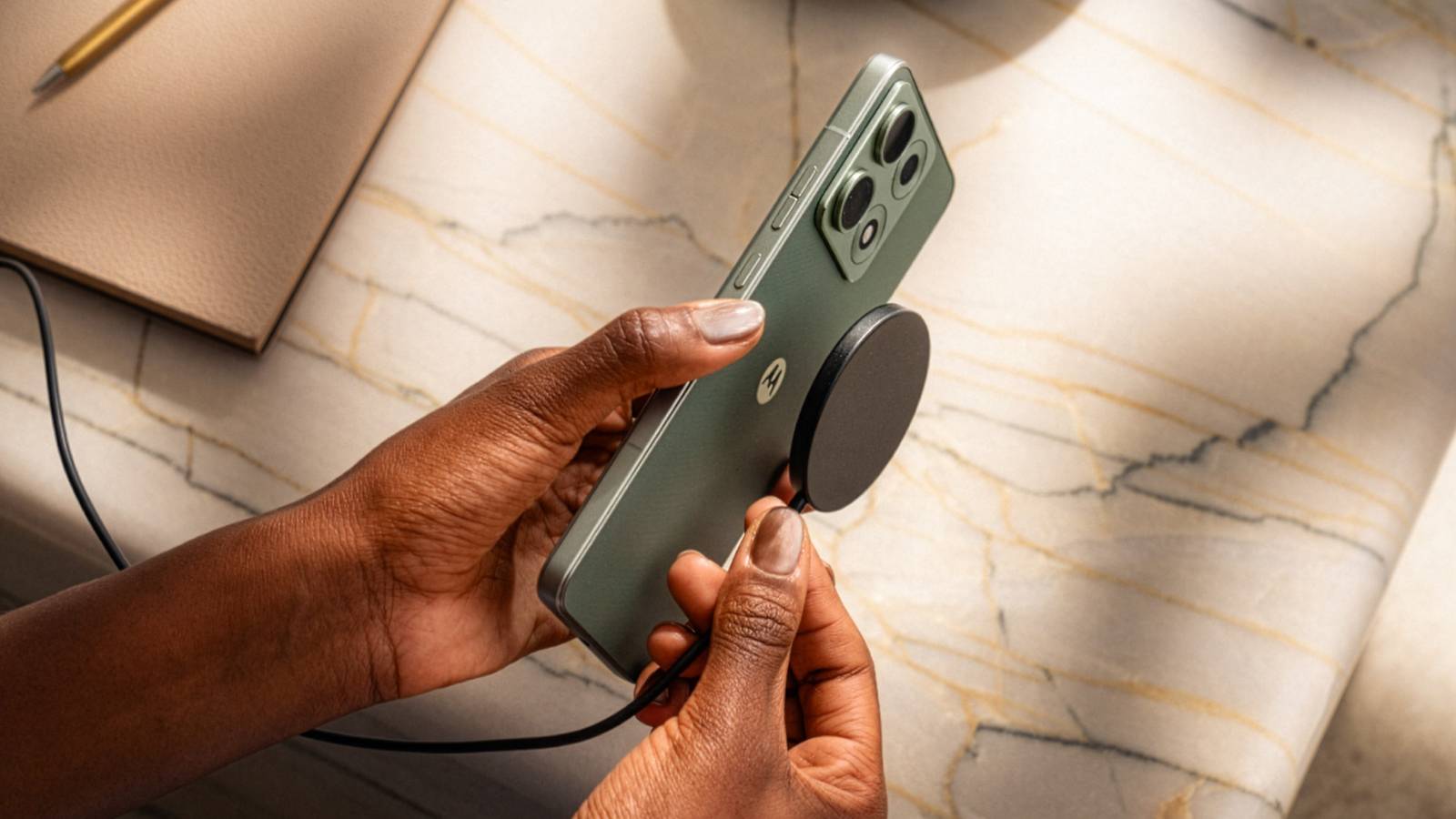
You might not have to buy a Google Pixel to get an Android smartphone with Qi2 magnetic wireless charging built-in.Well-known leaker Evan Blass has revealed that Motorola is working on a Moto Snap charger that hints at Qi2 coming to its broader phone lineup.The apparently leaked images depict a simple puck resembling Google's Pixelsnap Charger or Apple's MagSafe Charger.
Given that Motorola launched its only Qi2-native phone (the Moto Edge 70 Max) without a first-party charging solution, this suggests the company is committed to magnetic charging beyond a single phone.Google Pixel 11 Brand Google SoC Google Tensor G6 See at Amazon $899 at Best Buy $899 at Google Store Expand Collapse It's not certain when Motorola might introduce the Moto Snap, but parent brand Lenovo typically holds events linked to major trade shows, such as the upcoming IFA in early September.If so, the charger might launch alongside one or more phones.
Don't expect every Motorola phone to support Qi2.Its roster is focused on budget-oriented devices like the Moto G series, most of which don't have any form of wireless charging.This could be reserved for mid-range and high-end models.
Why don't most Android phones support Qi2? Design, cost, and stubbornness The Wireless Power Consortium announced the Qi2 standard in January 2023, and formally launched it in November that year.There have been plenty of opportunities for Android phone makers to adopt the technology, but built-in support is limited to the Pixel 10 series, Pixel 11 family, and the HMD Skyline.Only Apple (whose MagSafe technology is the basis for Qi2) has consistently supported it from the start.
Samsung, OnePlus, and other Android vendors have indirectly supported Qi2 through cases, but those accessories carry extra costs and aren't always as versatile.Related Dear Samsung, “Qi2 Ready” Doesn’t Mean Anything Without Magnets "Ready" without the most important component.Posts 19 By Joe Fedewa These companies haven't usually explained why they don't support Qi2, but there are multiple factors at work.
Nothing claimed in 2025 that while Qi2 is a standard, the magnet setups needed for iPhone-friendly wireless chargers are patented.Manufacturers would supposedly need to develop their own solutions to achieve similar speeds.While this isn't necessarily a problem for major companies like Google and Samsung, smaller firms like Nothing might balk at the expense.
Aesthetics can matter.Samsung explained the absence of Qi2 in the Galaxy S26 series as a "commitment to thinner, lighter designs." Effectively, companies like Samsung argue that the thickness and weight of Qi2 magnets aren't worth the added convenience.It's also no secret that some brands, including Oppo (OnePlus' parent) and Xiaomi, favor proprietary charging solutions.
The OnePlus 13 and 15 can wirelessly charge at up to 50W, but that requires a custom magnetic wireless charger and a case to match.Qi2's maximum 25W speed (as of this writing) isn't as marketable and could reduce accessory sales.
Read More