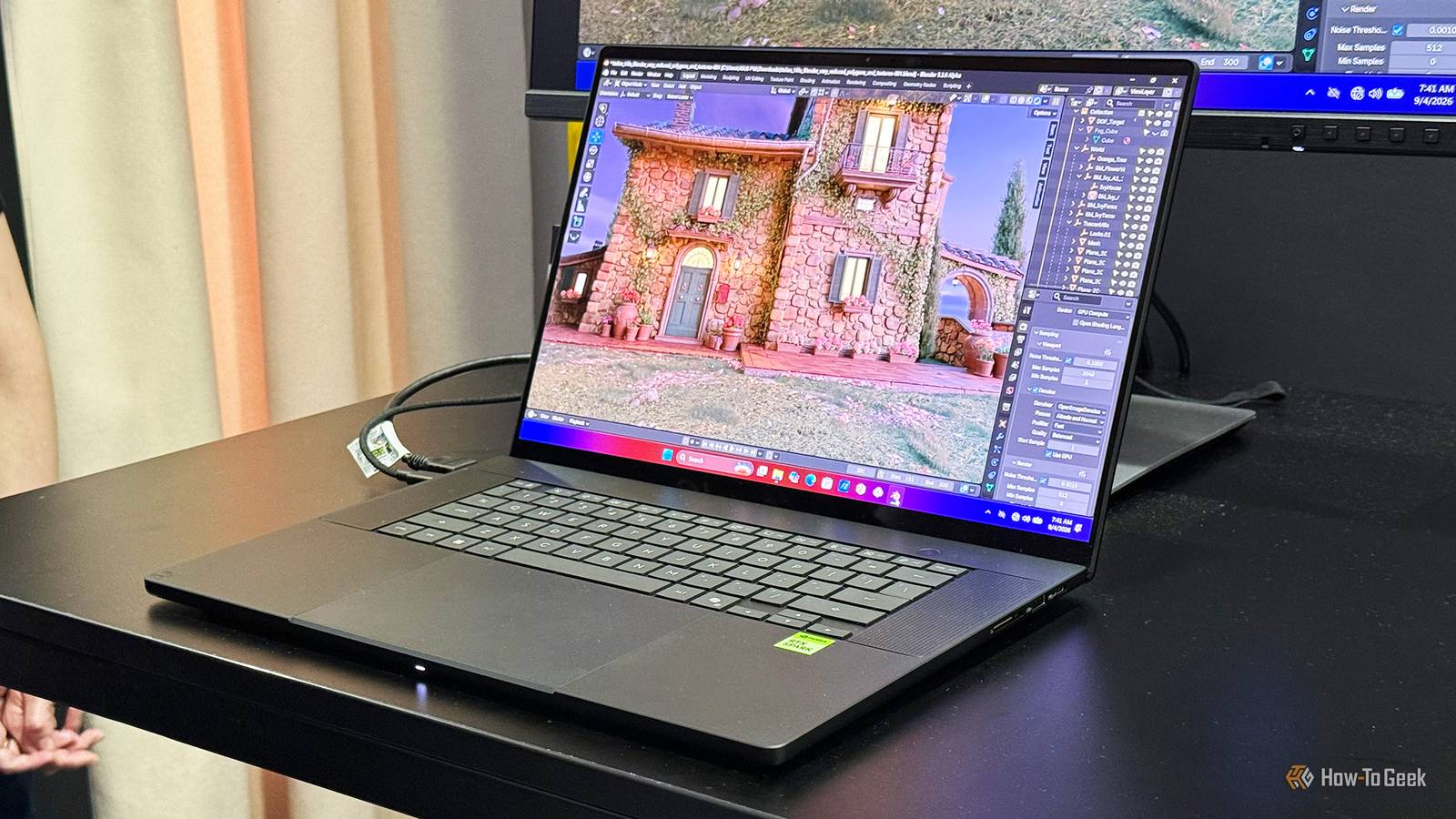
Nvidia is slowly lifting the veil from the first PCs with its RTX Spark chip, and it's now clearer what they can do.I had the opportunity to demo several computers from Asus, Dell, Microsoft, and other brands at IFA 2026, and they promise to transform computing — although some big questions remain.I started with first-hand experiences of more demanding tasks that made use of the 6,144-core Blackwell RTX GPU.
Maxed-out models with 128GB of unified RAM could handle 90GB Unreal Engine 5 worlds that would crush many other PCs.They could not only run large AI models (including recent versions of Qwen), but handle parallel AI tasks with over 60GB of memory in use.Agents could tell Adobe Photoshop how to draw images, and 3D rendering tools like Blender could use DLSS frame generation to denoise complex scenes without blurring between frames.
Close This being Nvidia, gaming was on display.I and others got to play , , and other major titles.While I couldn't use frame counters, the games ran smoothly (often clearly at or above 60 frames per second) even though they relied on Windows 11's Prism emulation for ARM-based processors like the RTX Spark.
I expect better frame rates once promised ARM-native versions arrive, although there aren't exact timelines for those.Prism is receiving another upgrade this fall to make full use of Nvidia's new technology, not to mention support a wider range of anti-cheat programs that currently thwart Snapdragon PCs when running some games (such as Riot's ).Expect the software to match the hardware at or around launch.
The computers themselves are all premium systems at this stage.Asus' ProArt P14 and P16 laptops are explicitly aimed at media creators who value color accuracy along with speed.The Microsoft Surface Laptop Ultra is a wonderfully minimalist portable for power users of all kinds.
I already tried Lenovo's Yoga 9n models (the 2-in-1 in particular could be a great convertible), and also had experience with the Dell XPS 14 and 16 (in RTX Spark trim), HP OmniBook Ultra 16, and MSI Prestige N16 Flip AI+.Almost every system had a full-spec RTX Spark with 128GB of RAM, the 20-core Grace CPU (co-developed with MediaTek), and the maximum GPU core count.There was an OmniBook Ultra 16 with 'just' 64GB of memory, so Nvidia wasn't completely dependent on top-tier versions to make its case.
Some models, such as the XPS 14, are almost certainly going to ship with less memory in base form.Desktops are still rare, but Asus was happy to show me the ProArt GR1X Mini PC.Think of it as an alternative to the Mac Studio or Nvidia's own DGX Spark workstation.
It's a very compact but powerful machine for creators and developers who need nonstop GPU power, whether it's for media processing or always-running agentic AI like Hermes Agent.What we still don't know about RTX Spark: real performance and prices It's unclear how they stack up versus rival PCs For all the time I spent with the first wave of RTX Spark PCs, one thing was clear: Nvidia is still reluctant to share everything ahead of the platform's fall release.Benchmarking wasn't an option in my sessions, and the company chose apps that showcased RTX Spark's best software uses with high-powered configurations.
I don't want to only see tests running on PCs with 64GB of RAM or more — I want to know how 'entry' 24GB models run.Related This $3,999 AMD mini PC replaces expensive cloud AI without the Nvidia price tag Ryzen AI Halo takes on Nvidia's DGX Spark while using Windows or Linux.Posts By Jon Fingas Pricing is equally unknown.
It's not certain if these PCs will be competitive with computers running comparable AMD, Intel, and Apple processors.The early models all sit in their manufacturers' high-end lineups, so they aren't budget models, but I'd like to know if I'll get at least as much value for my money.Apple's Mac mini and Mac Studio in particular have developed reputations as fast-yet-efficient AI computers.
Demand has been so strong that they've faced long-lasting shortages that forced Apple to discontinue some models before a late August upgrade.Nvidia will have to persuade early adopters that it can deliver a similarly good speed-to-spending ratio.And if money is no object, you can rely on brute force through components like RTX Pro GPUs and many-core CPUs.
My initial experience is positive, though, and it's evident that RTX Spark has advantages with apps that depend on massive amounts of memory or GPU power.It's just a question of whether Nvidia can make a good first impression with customers, not just the press or enthusiasts.For that to happen, the company will have to be more transparent than it has been so far.
Read More