Building software without writing code has always felt more like a chore than helpful to me.I could never handle blueprints, Scratch, or anything like it.Google Opal is a good alternative, though, because it lets me describe what I want in plain English.
It turns my prompts into applications without the usual overhead.Natural language to visual logic Hopefully, this means the end of dragging and dropping I've had platforms force me to use rigid, hard-coded templates and drag-and-drop interfaces that felt more like a chore than a way to build an app.Choosing a game engine without learning to program today feels awful thanks to those empty no-coding promises, and it felt like regular apps would always have the same problem.
I know a bit about programming, but I used to struggle with manually setting up layout hierarchies, database bindings, and API routing.I tried platforms that promised low to no coding, and hated every one I tried.I tried using the drag-and-drop coding in Unreal, Unity's alternatives, Scratch, and others, but I actually learned how to code because of how complicated the easy path was.
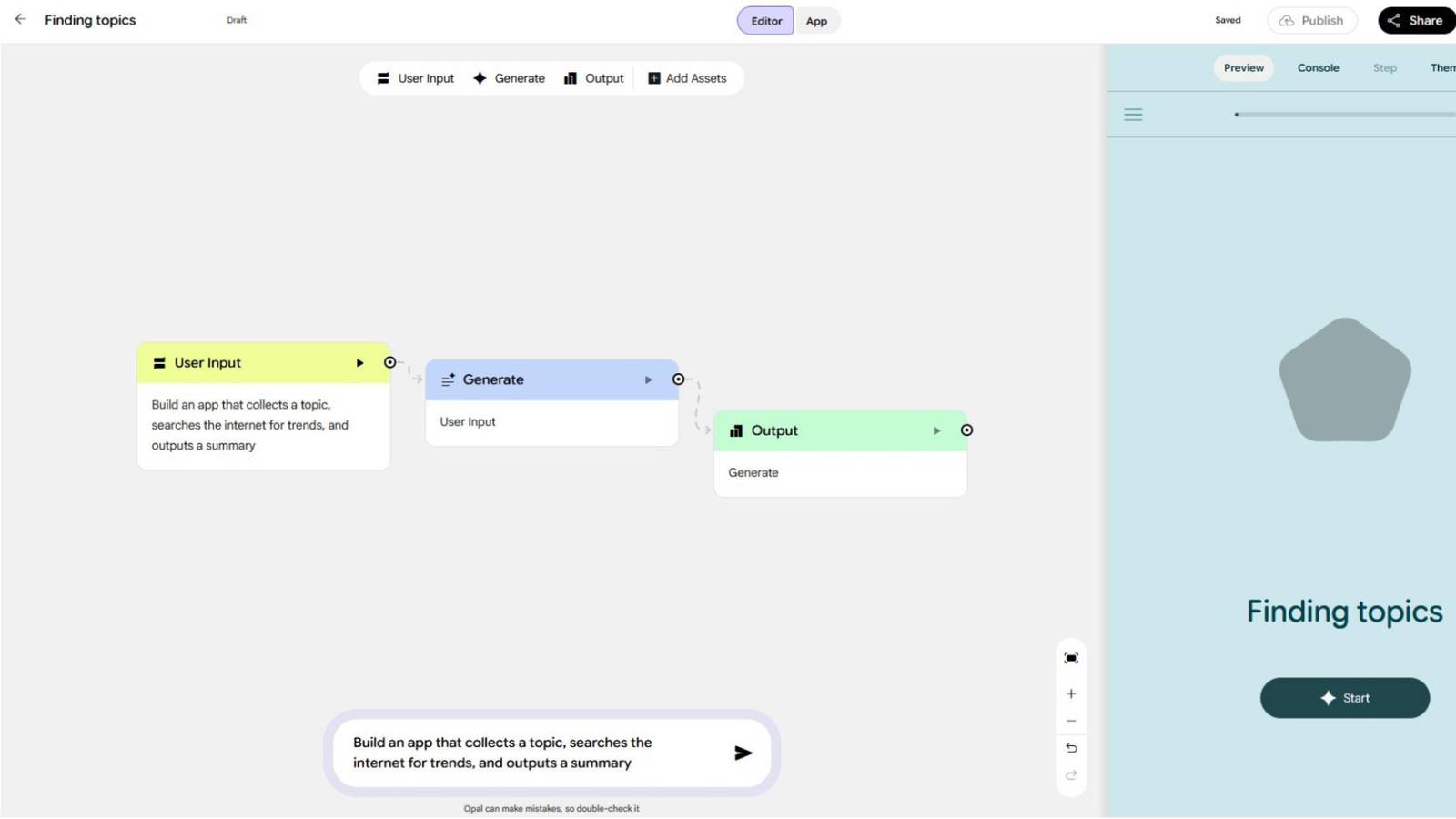
I wish Google Opal were around earlier, because it uses its AI to translate your words directly into a visual workflow.This is a lot like Gemini.Instead of wrestling with interface components, I just describe my application in plain English.
I type a prompt, like an app that collects a topic, searches the internet for trends, and outputs a summary, and the platform handles the rest.Opal figures out what your app needs to do and builds the interface automatically.Instead of writing messy code from scratch, it uses pre-made pieces that connect to your data.
Once the layout is ready, Opal handles all the heavy lifting, from running the AI models to hosting the webpage online.You get to skip the entire software engineering process.By turning normal speech into a functional layout, Opal proves you can build an app without touching a single line of code.
Deep multi-model chaining You're using multiple models in a way that isn't confusing Stringing together different AI models into a single application has been incredibly difficult.I've watched Antigravity try and still mess it up.It usually means writing complex code to connect different APIs, dealing with slow response times, and building custom code paths just to get systems to talk to each other.
It's a big deal, and usually I have to have Claude act like a manager or a go-between, because even Antigravity can't do everything and stay focused.With Opal, you can build these connections directly in the visual interface.The platform handles all the background tracking, automatically passing the results from one step into the next one using simple variables.
This means the output of one step instantly feeds into the next.This way, instead of building a complex tool from nothing, you're building up to it logically.The third block connects that formatted data to a specialized computation tool or Python interpreter block.
This block executes the complex formulas, handles advanced calculus or trigonometry functions, and outputs the exact numerical answer.It's really that easy You can deploy small apps Make a calculator, not a groundbreaking appOpal is not a regular AI making apps, and leaving it for you.It is built to deploy apps.
After finishing a workflow, you just click a single publish button.Opal handles all the hosting and system needs, removing the need for web servers or complex deployment setups, and generates a single public link you can share with anyone.As long as the person has a Google account, they can run the app in their browser, copy the layout, or change it.
This makes it easy to collaborate since people can pass around small AI apps without worrying about hosting fees or background setups.This isn't as simple as it sounds, and I really don't think any non-coding app will be ready for heavy usage.Prompt-based app builders can only make fragile mini-apps that don't have the logic needed for serious software.
The worst part is that Opal hides the code, so you can't fix it easily, even if you know what you're doing.That also means it is bad for making large-scale enterprise software.Without the source code or database layouts, it's hard to fine-tune performance, manage massive amounts of data, or fix complex code loops.
Vibe coding is already a fragile way of programming, but vibe debugging is a ridiculous concept.This isn't the magic switch Google Opal isn't meant to replace professional software development or a real programmer.You lose access to the underlying code, which makes it hard to manage databases or debug specific logic loops when things go wrong.
That said, I don't need a massive codebase for every task I want to automate.When I need to turn a quick idea into a working tool for research or content, it removes the barriers that usually hold me back.It is a fast way to get things done without the engineering headache.
Google Gemini Google Gemini is a multimodal AI models and an integrated assistant developed by Google.It understands and combines text, images, audio, video, and code.As an AI assistant, it helps with writing, planning, learning, and productivity, integrated into Google Workspace apps (Docs, Gmail) and on mobile devices. Subscriptions Expand Collapse
Read More