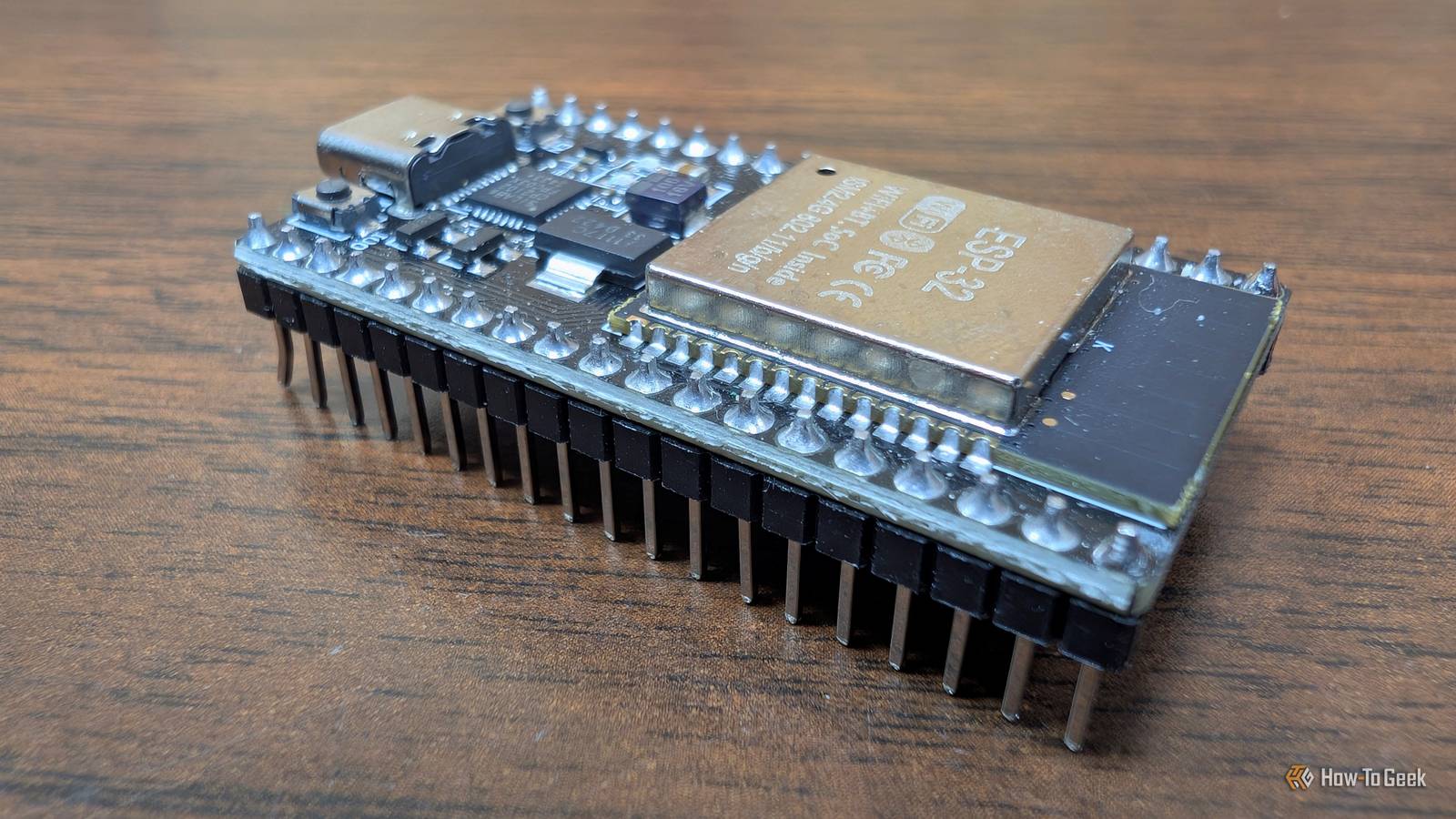
Many ESP32 boards come with Wi-Fi, Bluetooth, a microphone, and Thread or Zigbee support and are very affordable.That makes them great candidates for an experimental DIY smart home device—at worst, you have a board and a failed project that can be used later.These are 4 projects you can do to make your home "smarter" and more interesting without buying into a gigantic ecosystem.
Most of these projects require Home Assistant, though a few could be modified to work alone.A sunrise alarm that wakes you with light instead of noise WLED and an LED strip make waking up more pleasant Close Traditional alarm clocks produce a jarring noise to wake you up—no one enjoys it.Rather than rely on a buzzer, you can combine an ESP32, an addressable LED strip, and WLED to create a sunrise alarm clock instead.
Sunrise alarm clocks work by gradually changing the color and intensity of their light to mimic the rising sun; it starts low, and over the course of 20 minutes to an hour reaches peak brightness.It is designed to duplicate what your experience would be like in nature; some studies have shown that sunrise alarm clocks decrease morning grogginess.Related How to Make Your Own Color-Changing Nanoleaf Lights You could save some money if you already have a 3D printer.
Posts By Cherie Tan To build one, I'd recommend picking up an RGBW strip, which includes dedicated white LEDs, since they can more convincingly simulate the color of sunlight than a simple RGB strip.WLED handles the software side of things; you can program the LEDs to turn on at a specific time, automatically shut off, skip days, and more.If you use Home Assistant, you can tie the trigger to your phone's next-alarm sensor.
You'll also need an appropriate power supply for the lights and the ESP32 module.Lights that know you're in the room An mmWave radar sensor beats motion detection Standard PIR sensors (regular motion detectors) have a problem: they turn the lights off when you stop moving.If you've ever been reading a book, working, or worst of all, sitting in a public restroom when the lights kick off automatically, you've experienced that shortcoming.
To turn them back on, you often need to stand up and wave your arms around.You can fix that problem by combining an ESP32 board with a mmWave (24GHz) module.In practice, it works a bit like radar over short distances.
It can detect very small subtle movements, like flipping a page, shifting in a chair, or even your breathing.The costs of mmWave emitters and ESP32 boards vary, but you could build one for less than $10.I'd start with the LD2410—it works natively with ESPHome.
Once you have the hardware, you can use ESPHome to tune the behavior of the sensor to reduce false positives specific to your room.A voice assistant that runs inside your house The ESP32-S3 listens for the wake word on-device If you're not a fan of Alexa or Google Assistant (Gemini) because you have privacy concerns, you can build an alternative out of an ESP32 board, a microphone, and a PC.Using an ESP32-S3 (Either with a separate microphone or with the S3-BOX-3), you can run microWakeWord (a tiny AI model) that is designed to detect wake words.
No audio needs to leave the device for processing, much less leave your home network.Related The best smart home sensors are the ones you'll never see Your smart home doesn't need to look like one.Posts 1 By Tim Brookes From there, you can pipe the subsequent commands or questions to a PC or SBC running on your home network that handles the heavy lifting.
Depending on your specific configuration, you can enable text-to-speech, AI image generation, control your lights and other smart devices with your voice, and more.I've been experimenting with turning my AI assistant into a cooking assistant.If you're looking for AI models to try, I'd recommend Whisper, Parakeet, and Kokoro—they're all solid.
If you want something to help interpret what you say and map them to commands, I'd recommend running a small llama model.While DIY microphone quality won't beat a high-end Echo or Nest in a noisy room, it's more than enough for home control.A laundry notifier for your dumb washer A vibration sensor is all you need Close Smart appliances are expensive and prone to developing esoteric, difficult-to-fix problems that their older, simpler predecessors didn't have.
Fortunately, you don't need an off-the-shelf smart washer to get a notification when your clothes are done; you can make it smart yourself.All you need to do is securely attach an ESP32 with an accelerometer (like the MPU6050) or a vibration switch to the side of your washer.When the vibration stops, the ESP32 sends the signal that the laundry is done.
You can send the notification to every phone in the house or even trigger a voice announcement.To avoid false alerts that might occur during pauses in a spin cycle, make sure to use a delayed_off filter in ESPHome—basically, you need to tell it to "Wait and make sure" before it starts pinging people.If you want to get really fancy, you could configure reminders that will fire until you actually retrieve your laundry, or add an NFC reader that specifies which person is doing laundry, so only they get the notification.
The best project is the one that solves a problem Regardless of the project, you should buy boards with USB-C and verified ESPHome support.You're creating unnecessary hurdles if you don't.I also recommend printing or buying a proper case; you don't want a snagged wire to take the whole thing offline.
And like all ESP32 projects, they often stack.You can use presence data to control a thermostat, which is communicating with your home AI assistant.You could tie together the sunrise alarm with motorized blinds to get natural light in simultaneously.
You're only limited by your imagination and the parts you have.Today, vibe coding can handle 90% of the tedious stuff while you do the fun part—build things.
Read More