Image editors and desktop publishing tools keep getting better all the time.While I love a good dedicated publishing tool like Scribus, sometimes I need something quick to test layouts or make images/videos fast.There are plenty of image editing tools out there, but Canva and PenPot are two of the most powerful that I've used.
So I decided to compare them and see how they both fit into my workflow.I'm running this test on my desktop computer, running Linux Mint as the primary OS and self-hosting whenever possible.I am using the free versions of any software mentioned here.
I did not evaluate either app on mobile.Canva and PenPot are two very powerful image editing apps Although similar, they serve different purposes Pinta is my Photoshop stand-in of choice, but sometimes I like to dig a little deeper with my design software.I've heard nothing but good things about Penpot and I have extensive experience using Canva, so I figured I'd test both out.
Canva launched in 2013 and became a very popular editing tool for web pages, images, video, and so on.It's intuitive, the interface makes sense, and you can get in and get out with a decent-looking image in a few minutes.I like it because it makes complex design more accessible and I use it occasionally.
Unfortunately, Canva lost me a bit with the AI features.I even find background removal useful, but I don't like generating things.Plus, they're all locked behind a paywall and the last thing I need is another subscription.
PenPot hasn't been around as long as Canva, but its development can be traced back quite a few years before its general release.Today, it's open-source, you can self-host it (I'm going to use Docker), and it's free on the Professional tier according to the most recent sign-up page I used.There are plenty of subscription options that offer more features.
Related 5 Photoshop Alternatives for Linux Edit images with ease.Posts 4 By Haroon Javed Creating a multi-layered image in PenPot was eye-opening The software has a clear edge over Canva Close In PenPot, I wanted to do something a bit more complex with the tile card.First off, I find PenPot's shortcuts much simpler.
It took a moment to get used to the concept of boxes (the canvas within a canvas where you build your project).I'll say up front that there is a bit of a learning curve compared to Canva, but once you get into the workflow, it's actually quite simple.The interface is less cluttered and most of the menus I use don't require a shortcut or even an extra click to open.
Layers, Assets, and Tokens are always available on the left, the canvas/work areas sit in the middle, and design elements live on the right side of the screen.I put together a thumbnail for a Linux-related video.I started with the background design, which I made transparent and cropped tightly to provide a nice blue background.
Then, I added a PNG image featuring various Linux logos.After that, I put my favorite TV static image as an overlay and changed the transparency.No slider or bar; I just hit 2 to get it how I wanted it.
I applied a similar change to the background (9 this time).I also put a color burn on my static overlay.It turned out great, but exporting was a little bit of a challenge.
Making an image in Canva was remarkably easy, too It was intuitive and only took a few minutes For this test, I made two YouTube title cards with a canvas size of 1280 x 720.The first, in Canva, is for a retro-game themed video.In Canva, I used layers and transparency to build out the design.
It handled the background image quite well, but it did give me a little bit of trouble with saving and refreshing.It was incredibly easy and intuitive to adjust layer transparency, re-arrange assets, and get the overall look/feel of my design.Overall, Canva is quite good for making this kind of multi-layered image.
One thing I dislike about modern apps is the icon-based menu layout.I prefer shortcuts or labeled menus.I looked up a shortcut that I found useful in Canva: ALT + 1 for the layer menu.
On the downside, the shortcut support in Canva feels a bit limited for certain actions.Tools like crop and resize are easily found in the menu, though.I wanted to see if the apps could be self-hosted or not A simple metric by which I measure most apps I use It's no secret that I prefer self-hosting and using open-source software whenever possible.
That mean I won't use a subscription or a cloud-based app.I do on occasion, especially if I'm away from my desktop computer.Canva honestly gets a bit of an edge for its mobile app.
If I'm out and about, I can quickly and easily put together an image.This can come in handy for folks who are mobile-first/prefer mobile or if you can't be near your computer.The desktop version is easier for me to navigate than the app, but it offers similar features.
Since Canva is SaaS software, you sadly can't self-host it.PenPot is also professional-grade software and scaleable.But more importantly, it can be self-hosted.
I used Docker to get a PenPot image up and running on my desktop.So, PenPot earns the first point in this competition.I downloaded the YAML file with wget, set it to port 9001, and ran docker compose up -d.
It was up and running in no time.Related These 5 Free Video Editors Are Great for Beginners These free picks are perfect for people who are getting started in video editing.Posts 2 By Debbie Gluzband I tested AI features in both apps The results were pretty much what I expected Close The AI features in Canva are not my cup of tea.
Canva touts its AI features as a selling point for its higher-level subscriptions.The background removal tool is useful, and the software did okay, removing a few elements from the photo.Canva has an AI image generator that can generate an image for you or help you edit an image.
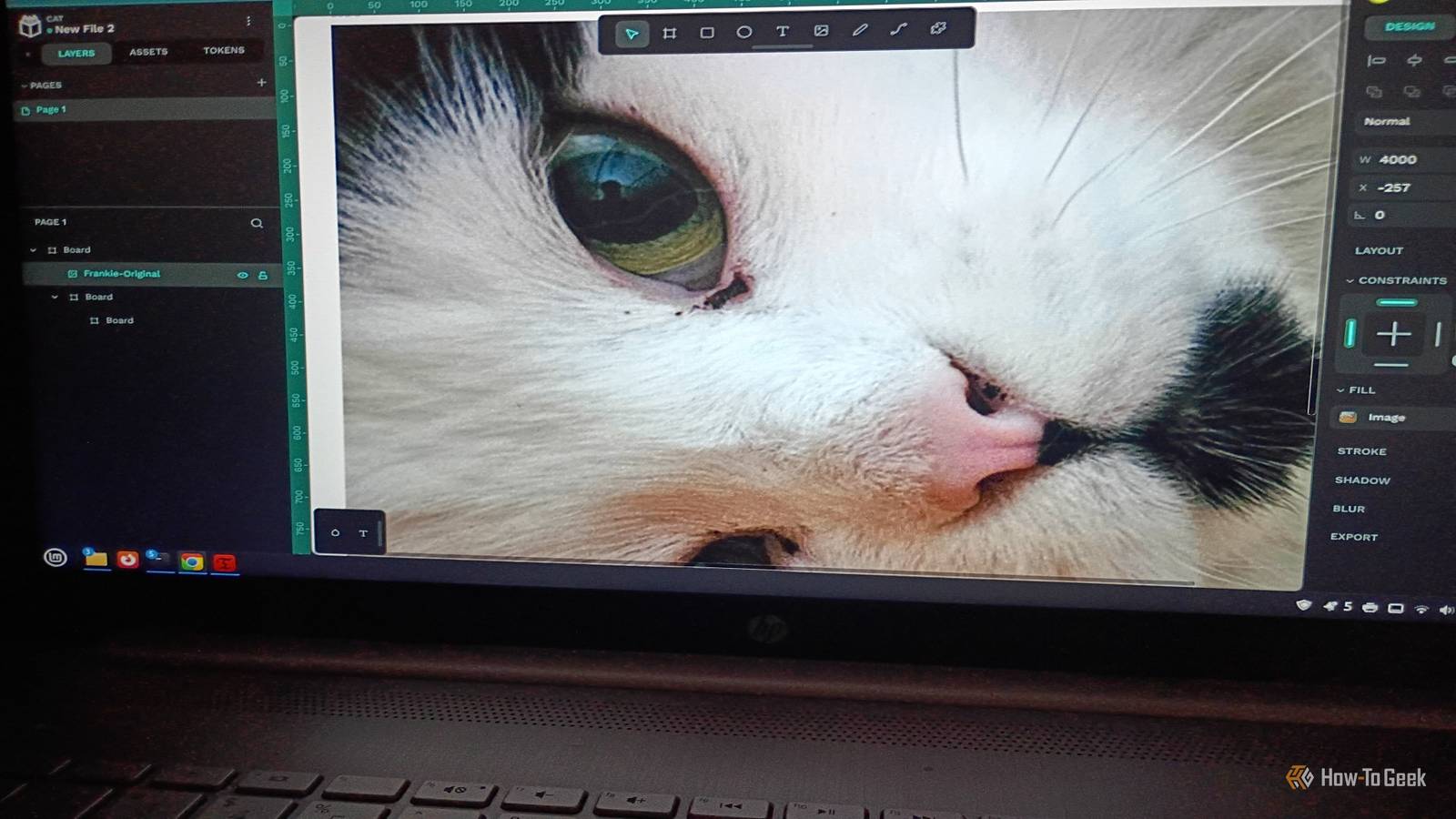
I tried it out with a picture of my cat sitting next to my phone.I was thoroughly unimpressed.It was sluggish, didn't want to follow instructions, and when it did, the edits looked awful.
I feel like it's simple enough just to edit the image yourself.AI-generated images and slop annoy me.When I used Canva to see what edits it could make to my cat picture, I wasn't happy with the results.
It did an okay job of removing the phone from the background, but Pinta and the Clone stamp did it better, in my opinion (plus, it was way more fun to make and it only took 10 minutes).Even with the weird patterns, it looks better than AI (in my opinion): As for PenPot, the AI integration and setup varies (by external providers setup, requirements, etc; there are many different factors), and is being spun as a quick way to prototype things rather than do the work for you.I wanted to test the plugin that allows you to prototype ideas, but it requires paid access to an LLM that offers API keys and (at this time, anyway) I have a policy of not paying for AI.
I've seen some examples, though, and they're about what I expect from so-called AI "assistance." I still prefer doing things myself, so I'd say in this category, both apps were a draw.Related I replaced Microsoft Paint with a powerful open-source alternative Paint has evolved past what it needs to be.Posts 15 By Nick Lewis While both image editors are great, I ultimately chose the self-hosted one The clear winner, for me, is PenPot.
I like the open-source, self-hosted nature of the software and its ease of use.In the future, I feel as if I could do anything from building a zine to making full-fledged YouTube or music-related videos.I think Canva has its place as well, but for me, PenPot has just enough of an edge to win a permanent place in my workflow.
Read More