In the United States, approximately 20% of the 42,915 people killed in motor vehicle crashes in 2021 were vulnerable road users, defined as pedestrians, cyclists, and wheelchair users.Contributing factors to the high number include distracted driving and speeding, with school zones among the highest-risk areas.Hyundai and Kia have announced the development of a new technology called Vision Pulse, which leverages ultra-wideband (UWB) signals to more accurately pinpoint the location of vulnerable road users.
Once detected, an alert is issued to inform the driver so they can take preventive actions if needed.A demonstration video on Hyundai’s YouTube channel shows how Vision Pulse technology notifies school bus operators of a child’s exact location.Cars and pedestrians can "see" each other Vision Pulse leverages the promise of V2X Vision Pulse falls under the larger umbrella of V2X technology, short for “vehicle to everything.” The general premise is that if a vehicle could communicate with everything around it while driving—pedestrians, infrastructure, other vehicles, and so on—then roads would be safer.
For example, if I am driving and you are riding a bike, at some point my vehicle's instrument cluster or infotainment screen will notify me of you.Likewise, you are notified via your smartphone, either visually on the screen, through your Bluetooth headphones, or through some other type of haptic feedback of me coming down the road.The idea is that if we are aware of each other, we can avoid each other.
V2X is a foundational component of fully autonomous vehicles, and its successful implementation is essential for self-driving cars to deliver on their promises of safety.A NHTSA study cited by the NTSB in 2022 estimates that V2X could reduce crashes involving non-impaired drivers by up to 80%.In the case of Hyundai and Kia and Vision Pulse, it’s less about autonomous cars and more about capitalizing on the safety benefits of V2X.
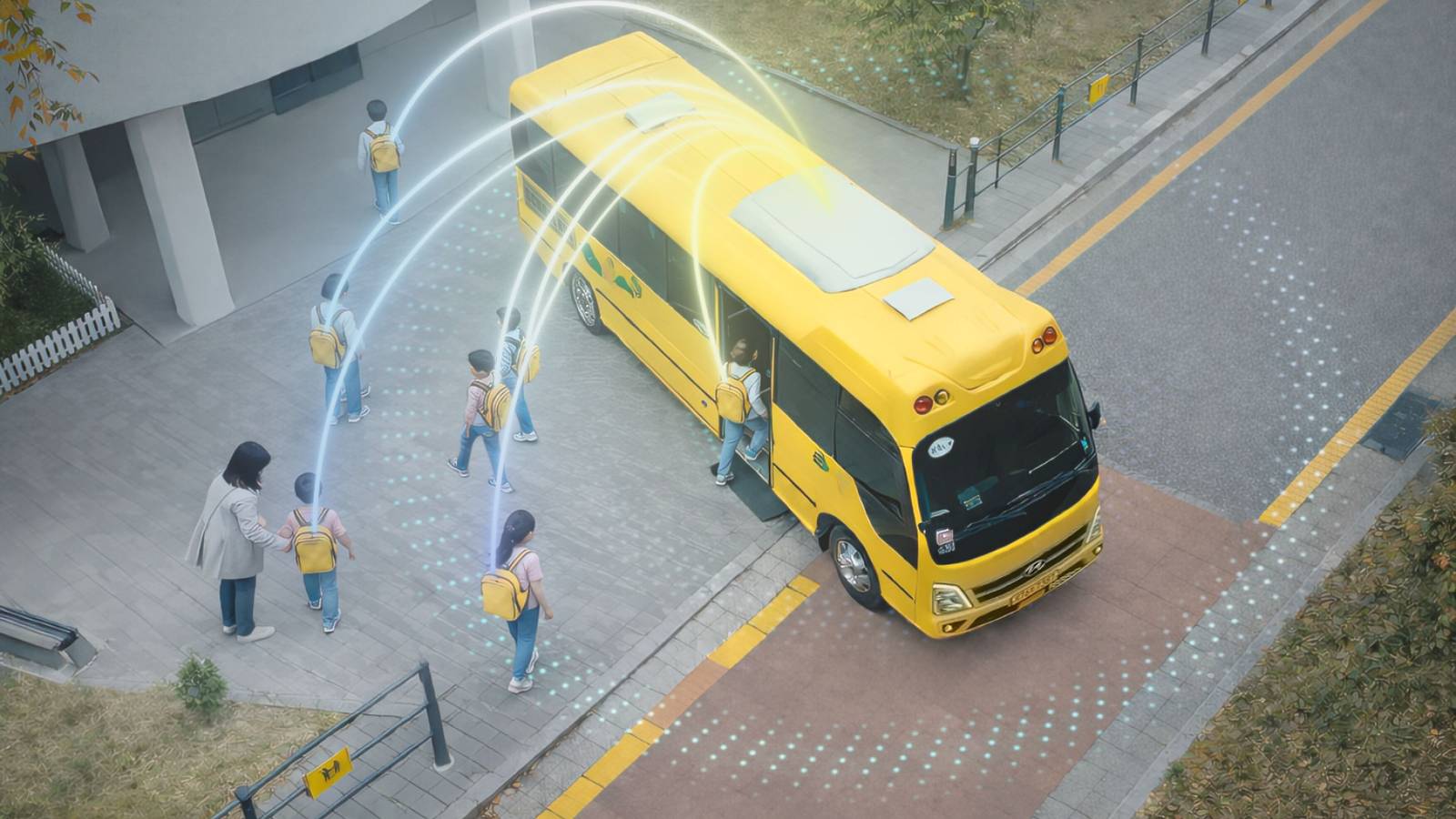
Although the automakers are still evaluating Vision Pulse and its potential for mass production, UWB modules would be installed on vehicles they manufacture.If other vehicles, cyclists, or pedestrians also had a UWB device, they would, in essence, be “compatible” with the Hyundai and Kia vehicle.Works through "anchors" and "tags" May integrate with automatic emergency braking The demonstration video on Hyundai’s YouTube channel shows how small Vision Pulse “anchors” can be mounted to a school bus.
Meanwhile, children who ride the bus carry little stuffed animals that attach to their clothing or backpacks.Each stuffed animal doubles as a tag for the Vision Pulse anchor.Once the anchors and tags are connected, the school bus and its operator can determine a child’s exact position and trajectory.In the video, a child runs out from behind a fence in a small alleyway, but the bus operator can see the child’s location on a tablet well before that.
Jung Hun Choi, a senior engineer with Hyundai and Kia, said that Vision Pulse technology detects people who may be obstructed from a driver’s view by a wall or building.In this way, Vision Pulse technology can complement cameras and LiDAR, which cannot see through or around physical objects.As long as a child is wearing their tag, any vehicle equipped with Vision Pulse technology can detect them and notify the driver accordingly.
Although this particular example from Hyundai and Kia focuses on a school zone (and with good reason), Vision Pulse has applications anywhere pedestrians are moving about.When the UWB modules of the vehicle and the pedestrian detect each other, the system measures the time it takes for signals to travel between the modules, calculating their exact positions (this is when an alert is issued to both the driver and the pedestrian if a potential collision appears imminent based on their current trajectories).Vision Pulse, operating on GHz bandwidth, can simultaneously detect multiple objects and road users near the vehicle, even when they are moving at higher speeds.
The automakers said Vision Pulse technology is effective in adverse weather and at night, achieving a detection accuracy rate of over 99 percent, with communication speeds between the vehicle and other objects ranging from one to five milliseconds.Although Hyundai and Kia did not specify, it seems likely that Vision Pulse would integrate with something like automatic emergency braking.If the driver failed to act in time after being notified of a vulnerable road user, the vehicle's brakes would deploy automatically.
Vision Plus may address current limitations Life-saving potential One of the primary limitations of radar-based safety technologies, such as automatic emergency braking with pedestrian detection, is their ability to operate in less-than-ideal conditions.Within the automotive industry, many who work on these systems acknowledge the need for continued improvement, citing a 2019 AAA study that found most of them fail at safety-critical moments, even in broad daylight and at low speeds.It’s likely that Hyundai and Kia engineers are aware of these limitations and are proposing Vision Pulse and its UWB signal integration as a solution, especially at higher speeds and in poor lighting conditions.
How-To Geek Report: Subscribe and never miss what matters Unlock your tech-savvy potential and master the digital world with How-To Geek.Subscribe By subscribing, you agree to receive newsletter and marketing emails, and accept our Terms of Use and Privacy Policy.You can unsubscribe anytime.
According to Hyundai and Kia, Vision Pulse can detect objects at an intersection with a 10-centimeter margin of error, across a 100-meter radius.In the 2019 AAA study, conducted on a closed course using simulated pedestrian targets, all test vehicles collided with the adult pedestrian 100% of the time after a right-hand turn.In the future, it would be interesting to see data from Hyundai and Kia on whether the fast detection capabilities of Vision Pulse translated into a system like automatic emergency braking.
If so, technologies like Vision Pulse could save countless lives.Beyond road safety Vision Pulse and industrial settings Beyond passenger vehicles, Vision Pulse may have applications in other situations and environments.Evaluations are ongoing at Kia’s Conversion Center in Hwaseong, South Korea, and at the Busan Port Authority to help prevent collisions between facility vehicles, such as forklifts, and employees.
First responders could also deploy the technology to locate people in an emergency.The automakers said even though Vision Pulse is still in development, vehicles equipped with Digital Key 2 already include the UWB modules, so no additional hardware is required for use.Digital Key 2 is equipped on a number of Hyundai and Kia vehicles, including the Palisade, Santa Fe, and Kona for Hyundai, and the EV9, Carnival, K4, and K5 for Kia.
Read More