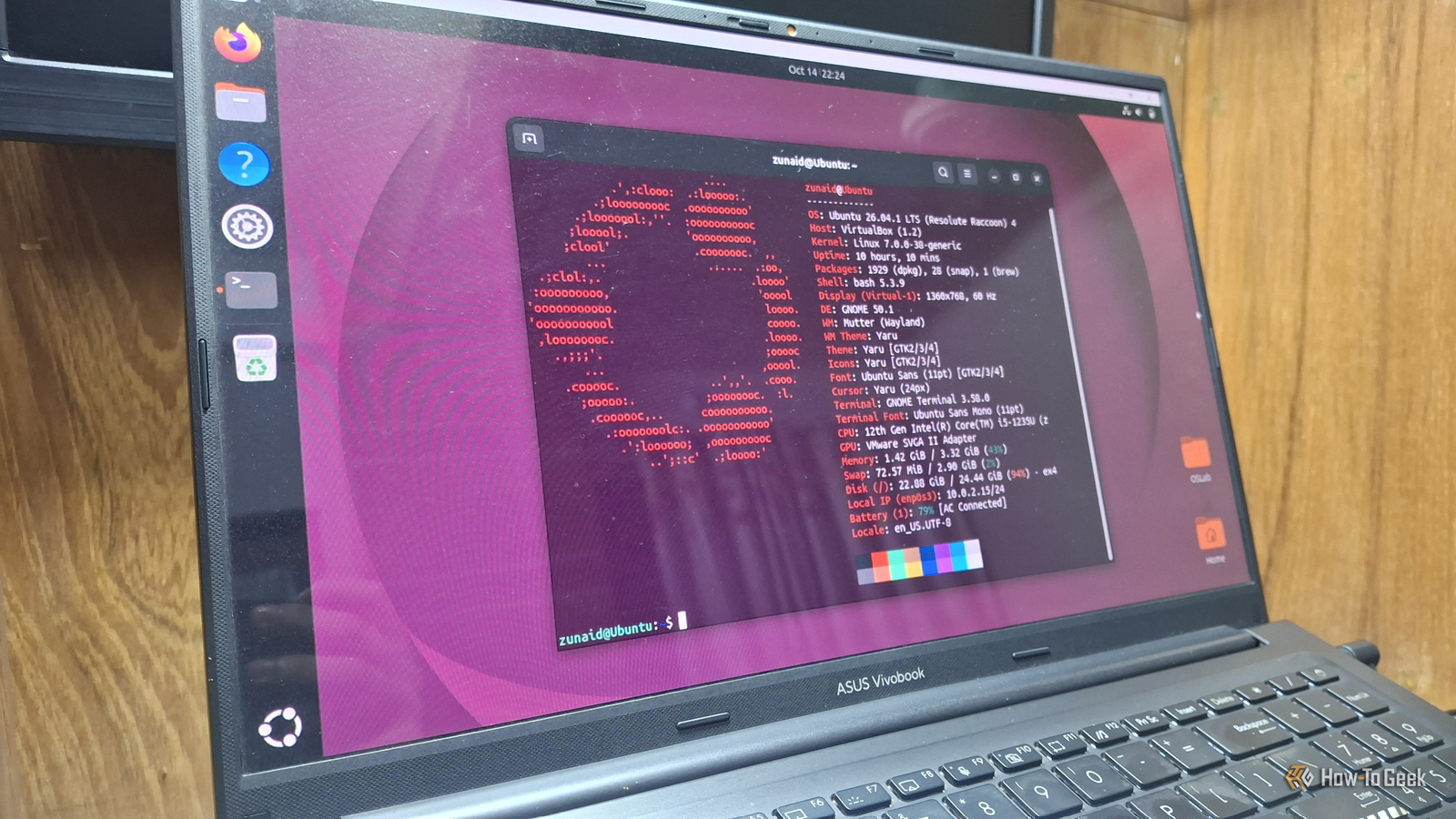
Ubuntu was my first distro.I started with 20.04 LTS Focal Fossa and am still running it to this day, trying out every long-term support version along the way.The reason why I chose Ubuntu? It was everywhere.
I've also used several other distros.From the classic Debian to the niche Kali Linux for security folks.And at the end of the day, I return to Ubuntu whenever I need to get the job done.
It works the majority of the time.Now, while surfing online communities, I've seen a lot of hate for the distro as well.In most cases, those are legit criticisms.
Despite all that, it's safe to say that it still stands as one of the most popular Linux distros of all time.Today, I'd like to unfold the story of how Ubuntu reached that height.Ubuntu made Linux easy to get before it made it great Free CDs in the mail and a cheeky "Bug #1" put it in people's hands in 2004 Close When Mark Shuttleworth announced Ubuntu 4.10 "Warty Warthog" on October 20, 2004, he offered to ship you the CD for free.
You could even ask for a handful to give to your friends or your school.They called it the ShipIt program.If you're from that time, you know how tedious it was to get Linux on your machine due to slow internet.
Unfortunately, the ShipIt program came to an end in April 2011.They still distributed CDs in Ubuntu Local Communities and at events.By this time, Ubuntu had spread by miles, having sent millions of copies of CDs.
Moreover, Canonical, the company behind Ubuntu, still permitted you to copy and redistribute CDs on your own.You also have to consider who Ubuntu was competing against at the time of its release.It was Windows.
Two months before that first release, Shuttleworth filed Bug #1 on Launchpad, with the title: "Microsoft has a majority market share." With a promise of free software for everyone and to unshackle them from the hands of big software corporations, Shuttleworth's pitch resonated with the community.Once software targeted Ubuntu, new users kept landing on it Tutorials, educational institutions, and even Steam assumed you ran Ubuntu So, that was people's gateway to get into Canonical's software system.But what made them stay or adapt? That's another story to explore.
Gradually, Ubuntu didn't just gain popularity; it became the default choice in many places.When people mentioned Linux, they more or less thought of Ubuntu.Developers had to target where users were hanging out.
Users, on the other hand, had to follow the developers to receive maximum support.It was like a snowball effect.Steam is a popular example of that.
When Valve released Steam for Linux on February 14, 2013, it arrived through the Ubuntu Software Center with a simple tagline: best experienced on Ubuntu.During the beta, Ubuntu 12.04 was the only version Valve officially targeted.If you wanted to game on Linux back then, Valve was basically telling you to install Ubuntu.
Ubuntu's biggest wins happened away from the desktop Cloud servers, Windows, and CentOS's exit kept it everywhere In April 2017, Shuttleworth ended Canonical's investment in Unity8 and its phone ambitions, and moved Ubuntu back to GNOME for 18.04 LTS.He even admitted he "was wrong on both counts" about convergence.In the same post, he pointed the company at cloud and IoT, claiming most public cloud workloads already depend on Ubuntu.
According to Canonical's latest accounts filed with UK Companies House, its revenue grew 18% to $345 million in 2025.The majority of it comes from recurring software and support subscriptions.You can assume from this that Ubuntu's primary target might not be desktop users in the first place.
When CentOS was retired, Linux became fragmented into alternatives.The CentOS Project shifted its focus to CentOS Stream in December 2020, and CentOS Linux 7, the last version, reached end of life on June 30, 2024.In OpenLogic's 2025 State of Open Source survey, Ubuntu was the top planned destination for CentOS users everywhere except Europe.
Now, you can argue that it was only planned, and can't measure the real migration result.Still, when servers needed a free and predictable new home, Ubuntu was the easy answer.Ubuntu loses where people choose, and wins where they don't Gamers moved to CachyOS and SteamOS, but developers and companies still default to Ubuntu Here's where it gets even more interesting.
When it comes to Linux enthusiasts choosing their distro, Ubuntu is not at the top.In the September 2026 Steam survey, CachyOS came out on top, with 18.12% usage among Linux systems.SteamOS ran on 17.37%.
Add up all three Ubuntu entries, and you get just 8%.That's less than plain Arch Linux at 10.67%.However, when you look at the professional scenario, things are different.
In Stack Overflow's 2025 Developer Survey, 27.7% of professional developers named Ubuntu as their primary OS.That's far ahead of any other named distro.On servers, OpenLogic's survey tells the same story, with Ubuntu still the most used enterprise Linux distro.
Funnily, Microsoft is also a big help here.If you set up the Windows Subsystem for Linux with the wsl --install command, Ubuntu is what you get by default.So, Ubuntu isn't really winning the popularity contest.
It wins when someone else, such as an organization, an employer, an educator, or a cloud host, makes the call instead of the regular Linux user.Ubuntu doesn't need to be the best to be where everyone starts I went from 20.04 to 22.04, then 24.04, and now 26.04.Along the way, I tried many other popular Linux distros.
Some of them definitely outperform Ubuntu.Yet, I'm still here running it because, well, it's the default choice.And if you're stuck on your first pick, Linux Mint vs Ubuntu is a good starting point.
Read More