A sound system isn't a cheap proposition, and if you're going to spend the money, you don't want any regrets a year or two down the road.Rather than buying a soundbar, you should piece together your own system—it'll age better and offer better performance.Soundbars offer convenience over quality Soundbars have a physics problem Close Soundbars are designed with one thing in mind: convenience.
Open the box, slide the soundbar under the TV, stuff the subwoofer in a corner, and halfheartedly stick the surround speakers to the sides of your listening position.However, the speakers in a soundbar system are ultimately limited by physics in a way that a system with individual speakers isn't.One of the fundamental problems with soundbars is their size constraint.
They must fit between a TV and whatever the TV is sitting on, and even ones that wall-mounted are designed with that constraint in mind.That puts an unfortunate upper limit on the maximum size of the speakers they contain.Bookshelf speakers are usually built with both a woofer and a tweeter, with the woofer determining the minimum size of the speaker itself.
Most bookshelves opt for 5.25-inch or 6.5-inch woofers so that they can accurately reproduce the range of sounds you should be hearing on the screen.Even center channels usually opt for speakers in the 3–4.5 inch range at a minimum, whereas larger, high-end center channels will opt for the 5.25 inch or 6.5 inch woofers.If you want to produce full-range sound in your front and center stage, your speakers must be able to move enough air at the right frequency, and the cabinets need to be sized to optimize the sound the woofers produce.
A string of tiny speakers in a box designed to slide under a TV is going to struggle to keep up with larger speakers.Decent soundbars aren't cheap, and neither are individual speakers.However, between the two, you'll almost always get better performance for your dollar from the regular speakers.
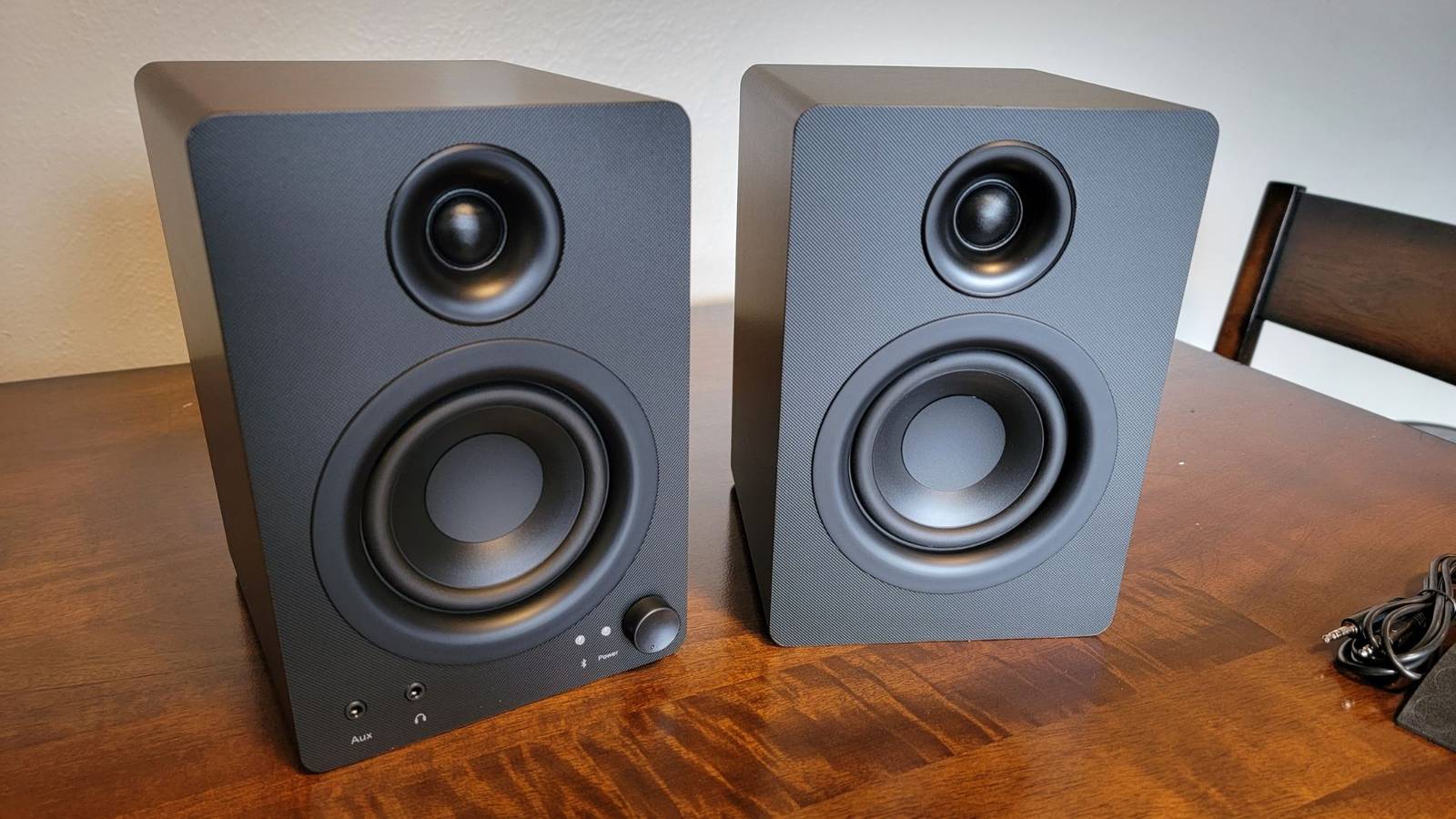
Emotiva XB1 Bookshelf Speakers Brand Emotiva Power 60W Nominal/120W Max Driver Size 4 inch Woofer, 22mm x 25mm Airmotiv Ribbon Tweeter Frequency Response 65Hz-25KHz With a 4 inch woofer and an Airmotiv ribbon tweeter, the XB1 delivers detailed sound that is as well suited to classical music as it is the latest TV show you've been binging. They're best paired with a subwoofer to reach the deepest notes.$450 at Emotiva Expand Collapse Soundbars often feature up-firing Atmos, which is literally just a speaker angled up at the ceiling to bounce sound down at you.It is designed to be a more convenient alternative to putting speakers on or in your ceiling.
At times, it works if your ceiling is ideal for it.However, things like fans, light fixtures, beams, and popcorn ceilings can all affect it.If you're interested in the immersion Atmos can offer, it is probably worth the effort to mount some in or on your ceiling. There is no room to grow A soundbar can't easily be upgraded When you buy a soundbar, the promise is a home theater experience in a box, and that is the case most of the times.
Depending on how much you spend, you may get something that is allegedly equivalent to a 5.1.2 system, which consists of a front left and right speaker, a center channel, two satellite speakers for surround sound, and a subwoofer.If you buy up, you may get additional satellite speakers for side and rear surround or up-firing speakers designed to replicate Atmos height speakers without actually placing speakers on your ceiling.Whatever specific soundbar unit you buy, they all come with one basic problem: there is no room to expand in the future.
If you buy a 5.1.2 soundbar, you're pretty much stuck with a 5.1.2 surround sound system.You can't easily add an extra set of surround speakers to improve your immersion.You can't usually add another subwoofer or replace the one that comes with the system—if the included one isn't enough (and depending on your room shape and size it may not be), you're probably out of luck.
Related Buying two subwoofers actually saved me money—here's how Two subwoofers beat one giant box and cost way less, but everyone makes this mistake if they don't know any better.Posts By Jorge A.Aguilar On the other hand, if you put together your sound system by buying individual speakers, you have more flexibility.
If you buy two front tower speakers, you can easily add in a center channel at any time to improve your sound.If you find that one big subwoofer doesn't give you even sound in your space, you can sell it and swap it out for two slightly smaller models that offer better coverage for your space or add another identical model.If eventually you decide you want to go all-in on spatial audio, you can add as many surround channels, height fronts, and Atmos speakers as you're willing to buy.
Piecing together your home theater doesn't just give you more control over sound quality; it helps ensure you can make your system what you want it to be, now and in the future.Soundbars don't age well Analog tech lasts forever; digital changes quickly Soundbars are designed to be all-in-one units.They contain an amplifier and have all the digital ports you need to connect them to a TV, and they often come with Wi-Fi and Bluetooth now, which enables you to control them directly from an app.
All of those features can be quite convenient, but they also put a shelf life on the soundbar.Subscribe to the newsletter for better audio decisions Curious how soundbars compare with component speakers? Subscribe to the newsletter for clear, practical breakdowns, confident buying guidance, and tips to future‑proof your speakers, subs, and Atmos setups.Get Updates By subscribing, you agree to receive newsletter and marketing emails, and accept our Terms of Use and Privacy Policy.
You can unsubscribe anytime.Digital standards move much more quickly than analog technology.A passive speaker from 50 years ago could easily be plugged into a modern AVR with two copper wires and some banana plugs.
On the other hand, it is much more difficult to predict if the current Bluetooth standard will be widely used in the future or whether that HDMI port on the soundbar will support whatever standard new TVs are using 15 years from now.And that doesn't even touch on app support.We've seen it happen time and time again.
A company designs a smart device that requires an app, and then, after a disappointingly short number of years, they drop support.Sometimes there are workarounds; other times the DIY or open-source community steps in and designs a replacement. Logitech’s Harmony Line Is Long Gone, but There’s Still Room for Universal Remotes Bring some order to your coffee table.Posts 17 By Don Melanson Whatever the specific situation, I'd much rather buy passive speakers that can be easily attached to a new AVR in the future than risk buying a soundbar that could be turned into an extremely oversized paperweight when a company drops software support.
Sound equipment is expensive; plan for upgrades Rather than buying an expensive soundbar every few years, you should buy individual speakers instead.They'll probably cost a bit more upfront, but they're going to last longer, and you can swap out every other component in your sound system however you want.If you decide that you want more surround speakers, you can pick up a receiver with extra channels.
If you want more powerful front left and right speakers, you can add a dedicated two-channel amplifier and send your bookshelf speakers to the sides as surround speakers.Piecing things together gives you an enormous amount of flexibility to make your sound system what you want it to be.
Read More