It can seem weird to spend good money on a capable drill just to end up chewing through screw heads, anyway.It is easy to assume the tool has too much power or the fasteners came from a bad batch of hardware, but I doubt it.Most of the time, the trouble comes down to how that little piece of steel meets the slot.
For clean results, it helps to understand why loose fits happen and how even a tiny mismatch can wreck a job.Fitting in the hole is not the same as fitting right Loose fits ruin your screws Close You've got to understand that drill bits and driver bits are two different things.Drill bits cut into stuff and make holes.
Driver bits are built to grip the inside of a screw head and turn the screw to clamp things together.For it to work, the driver bit and the screw recess have to match up closely.A loose fit means less contact area, which can cause wobble and strip the screw.
Screws come in many common head styles, and each has its own shape.Phillips has the classic cross with tapered walls inside the recess.Pozidriv looks similar, but its walls are parallel, and it has a second set of small ribs at 45 degrees between the main slots.
Robertson (some people call this a square drive) uses a square socket with a slight taper that grabs the bit tightly.Torx (star drive) has a six-lobe shape with broad curves, so the bit pushes almost straight into the recess walls instead of at an angle.Then you've got the plain hex socket, or Allen drive, which is just a six-sided hole.
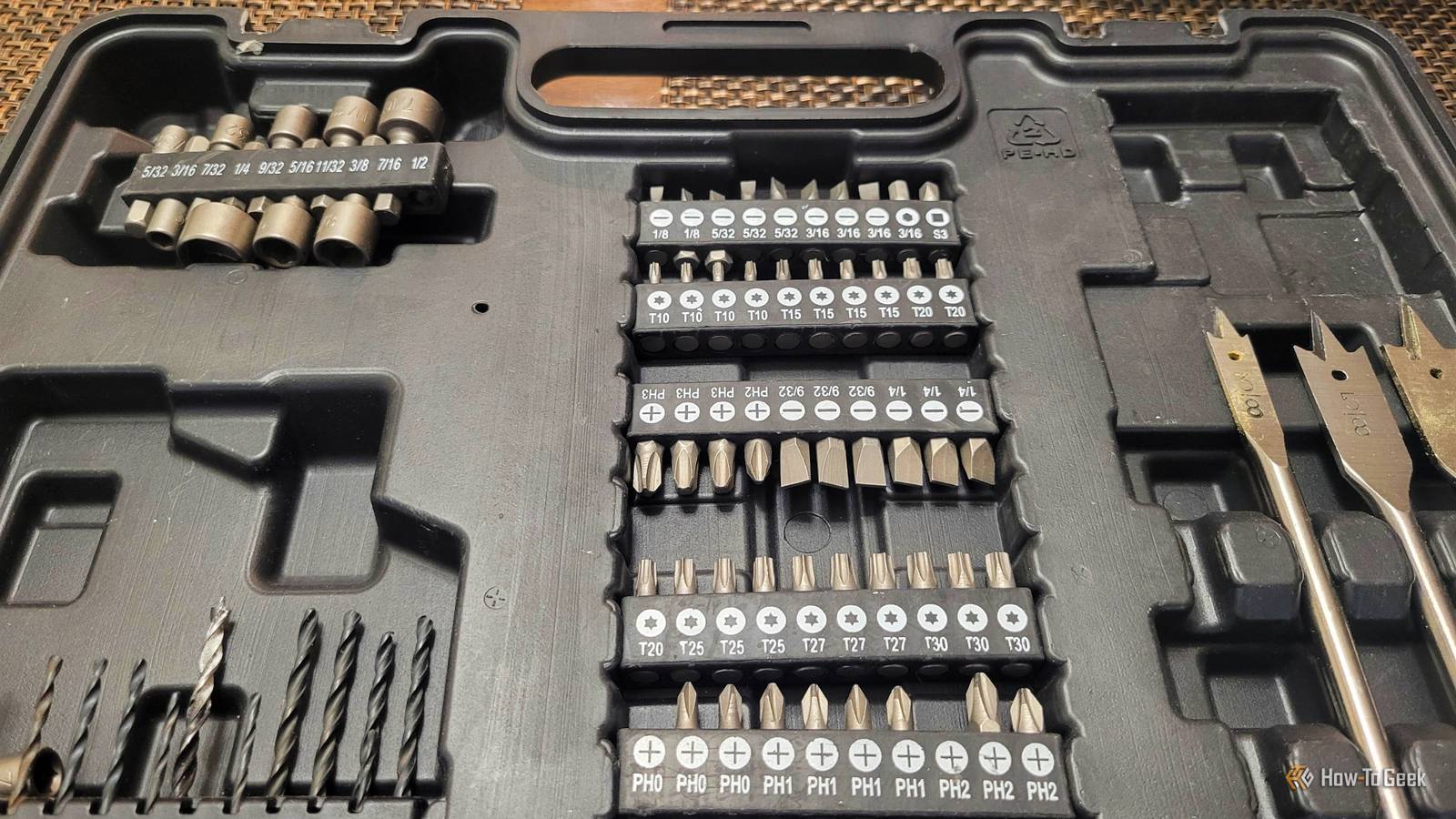
Each of these comes in its own set of standard sizes.Phillips bits get numbers like PH1, PH2, PH3, and so on, and PH2 fits most common wood and machine screws.Torx bits go by a T number, like T10, T15, T20, T25, T30, and T40.
If you use a bit one size too small, like a PH1 in a PH2 recess or a T20 in a T25 hole, it'll drop in, but it'll barely touch the walls.That skimpy contact makes cam-out way worse, and that's what you really have to avoid.Cam-out is just when the turning force on the screw also shoves the bit up and out of the recess.
Test the bit before you pull the trigger Hold your drill straight and set the clutch You'll need to figure out the exact head type and size of the screw you're using.Phillips and Pozidriv screws look pretty much the same until you look closely, but they're not interchangeable.Using the wrong bit on either one can wreck the screw and the bit.
Phillips screws have smooth cross slots with rounded corners and tapered walls.Pozidriv screws have small tick marks stamped between the main slots at 45-degree angles, and those line up with the secondary ribs on a Pozidriv bit tip.Before you switch the drill on, do a quick dry fit by hand.
Push the bit into a loose screw and check a few things first.Wiggle the bit side to side without pressing down.Any play at all tells you the bit is too small or the wrong type.
Then, you're going to want to look at how deep the bit sinks in.It should sit all the way down, with the wings or lobes touching before the tip bottoms out.One of the biggest checks is whether the screw stays on the bit when you tip it sideways or upside down.
A good fit holds the screw without a magnet.While you're driving, keep the bit perfectly aligned with the screw.Even a small angle shifts all the force to one side and triggers cam-out right away.
You've got to push the bit into the screw the entire time you're driving, not just let the driver rest on top.This is especially true with Phillips and Pozidriv screws.Set your drill's clutch so it kicks out before you get to the point where the screw strips.
Running in drill mode or at full torque pretty much guarantees you'll chew out the head once the screw sits flush.Keeping your speed sensible helps too, because too much RPM makes the bit spin out when the screw bottoms out.Also, make sure to drill a pilot hole first.
A pilot hole prevents wood from splitting and lets your driver bit work more easily.In softwoods, make a pilot hole about 70% of the screw's core diameter.In dense hardwoods, go closer to 90%.
Those are the woods where you should never skip the pilot hole.The metal and wear on your bit still matter Impact drivers need bits that can flex Even with the right bit profile and size, there are other ways to mess up.What the bit is made of and how it was hardened matter a lot.
Standard power bits are made from alloys like chrome vanadium or S2 tool steel, hardened to somewhere between 58 and 62 on the Rockwell C scale.That hardness holds up fine under steady rotation, but hit it with the hammering of an impact driver and steel that hard can crack or shatter instead of flexing.Impact-rated bits use the same kind of steel but treat it differently, so the core ends up a bit softer, around 55 to 58 HRC.
Most have a torsion zone, a narrowed section between the hex shank and the tip that acts like a tiny spring.It twists a little with each impact to soak up the spike before it reaches the tip.Wear matters too.
Even a correctly sized bit will strip screws if its edges are worn down from earlier use.Rounded or chipped faces add wobble and act just like an undersized bit.It's easy to blame a stripped screw on the drill being too strong, the torque setting being off, or the screws being cheap and soft.
Those things do matter, but they usually just make a bad fit worse.They're rarely the real cause.Even a small mismatch between the bit and the screw, plus high torque or soft screw metal, can make the damage happen faster and go deeper than it would by hand.
So if you want your new drill to work the way it should, you have to do your part.Even the best drill can't fix a bit that doesn't fit.Take the time you need Matching every fastener by hand will slow you down on quick jobs, but dealing with stripped heads and digging snapped metal out of fresh lumber takes far longer than checking the fit beforehand.
Knowing what fits saves your materials and keeps you from ruining your tools.
Read More