The parallel port is gone as of the time I'm writing this.But its demise was long and drawn-out, even as supposedly better alternatives came along and tried to take its place.Here's how it finally met its ultimate demise, long after it was supposed to.
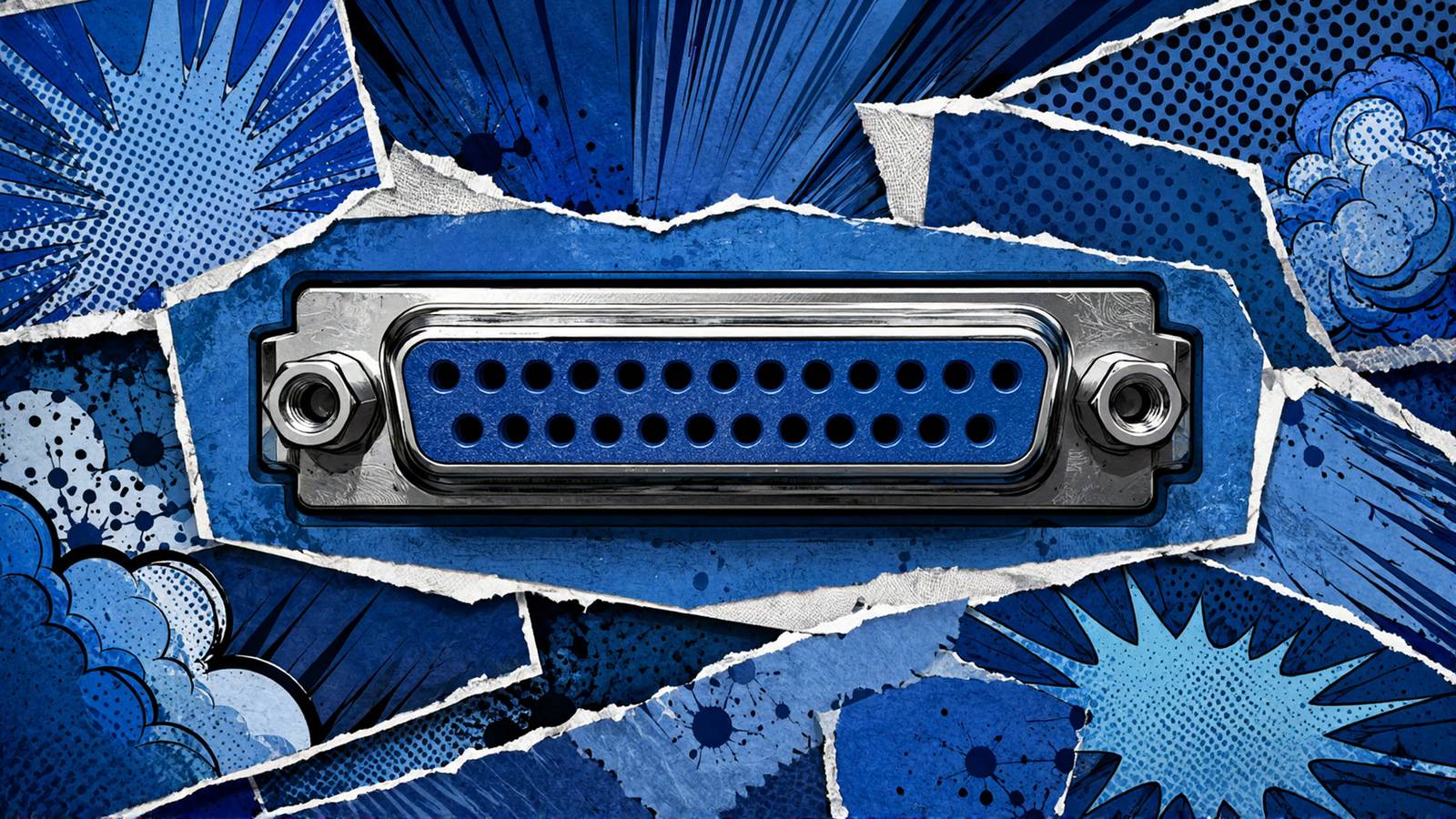
What's a parallel port, anyway? A look back at the connector that carried computing's data highway I'm not sure how many of you are too young to know what a parallel port is—I'm personally in my 20s, but I played around with my fair share of old computers back in the day and still do.But before USB became the default way to plug almost anything into a computer, the parallel port handled that job.Physically, it showed up as a wide, 25-pin D-shaped connector on the back of desktop PCs, commonly labeled LPT1 or LPT2.
Its defining trait was right there in the name: unlike serial ports, which sent data one bit at a time down a single wire, a parallel port pushed multiple bits simultaneously across separate wires, one byte at a time.That made it noticeably faster than serial connections for the tasks it was built for, mainly, driving printers.The standard traces back to Centronics, a printer manufacturer that developed the interface in the 1970s to connect its printers to computers more efficiently.
IBM adopted a version of it for the original PC, and it became a de facto standard across the industry long before any formal specification existed.That changed in the early 1990s with IEEE 1284, which codified the electrical and mechanical details and introduced faster, bidirectional modes like EPP and ECP, allowing data to flow both ways rather than just from computer to printer.Printers were the dominant use case, but far from the only one.
Parallel ports also connected external hard drives, scanners, Zip drives, and even early network adapters in pinch situations.Software developers relied on them too, since the port's direct access to hardware made it a convenient way to attach copy-protection dongles or debug embedded systems.Related USB-C cables look identical, but one simple spec separates the slow ones from the fast ones I thought all USB-C cables were equal until this one broke my workflow Posts 57 By Monica J.
White How did it last so long? Legacy hardware and industrial reliability kept it relevant Parallel ports should have disappeared not long after USB arrived in the late 1990s.USB was faster, simpler to use, hot-swappable, and didn't require a bulky cable with thumbscrews on either end.Yet parallel ports kept shipping on motherboards well into the 2000s, and in some corners of the industry, they never really left.
The reasons come down to inertia, cost, and the specific demands of environments where replacing working equipment wasn't a priority.A huge installed base of printers, particularly dot-matrix and early laser models used in offices, point-of-sale systems, and warehouses, depended on parallel connections.Businesses had little incentive to replace functioning hardware just because a newer port style existed elsewhere on the machine.
Receipt printers, label printers, and industrial control equipment often used parallel interfaces specifically because of their simplicity and direct, low-latency connection to hardware, something USB's more complex protocol stack didn't always replicate cleanly, especially in early implementations.Manufacturing and automation are where the parallel port really dug in.CNC machines, PLCs, and other factory-floor equipment frequently used the parallel port's pins for direct digital input and output, a technique still referenced in hobbyist CNC circles today.
Because these systems were built around the port's specific timing and signaling behavior, swapping to USB wasn't a simple driver update; it often meant redesigning the control software or the hardware interface entirely.There was also a software dependency problem.Countless line-of-business applications, especially those tied to specialized printers or measurement equipment, were written with direct calls to the parallel port's I/O addresses.
Rewriting or replacing that software carried real cost and risk, so companies kept the old ports around, and PC makers kept including at least one for compatibility, long after most people had stopped using them for anything else.How it finally died USB, integration costs, and shrinking motherboards sealed its fate Close By the mid-2000s, the parallel port's decline had become difficult to ignore.USB had matured into a genuinely universal standard, with USB 2.0 offering speeds that made the old parallel interface look sluggish by comparison, and manufacturers had refined driver support to the point where plugging in a device just worked, without the configuration headaches that sometimes accompanied early USB peripherals.
Printer makers shifted their product lines almost entirely to USB, and consumer demand for parallel-equipped devices dried up accordingly.Motherboard manufacturers followed the market.Including a parallel port meant dedicating physical space on the board, adding a Super I/O chip to handle the interface, and paying for the connector itself, all for a feature an increasingly small share of buyers used.
As PCs got smaller and slimmer, particularly with the rise of compact desktops and laptops, that tradeoff stopped making sense.By the early 2010s, most consumer motherboards had dropped the port entirely, and laptops had abandoned it years earlier.Operating systems played a role, too.
Successive versions of Windows gradually reduced native support and made parallel port configuration more cumbersome, nudging remaining holdouts toward USB-to-parallel adapters instead of native ports.Those adapters worked well enough for basic printing but often failed with software that expected direct, low-level access to the port, which caused real problems for the industrial and embedded systems still depending on that behavior.Today, native parallel ports survive mainly in specialized industrial PCs, older CNC setups, and equipment where replacing the control software isn't worth the cost.
For everyone else, the port lives on only as a USB adapter or a memory of unplugging a printer cable with two thumbscrews and far too much friction for something so mundane.Related Micro USB never actually died—here's the economics of why it's still everywhere You thought Micro USB was obsolete, but manufacturers had other plans Posts By Dibakar Ghosh A connector that refused to disappear quietly The parallel port outlasted its intended replacements not through superiority, but through sheer entrenchment in printers, industrial control systems, and legacy software that made switching more trouble than it was worth.
Read More