The Linux world has no shortage of software.A new distribution drops every other week, and more and more developers are creating FOSS alternatives to popular proprietary apps.However, the same can’t be said about the Linux hardware space.
Most of what we get are laptops that ship with Ubuntu preinstalled or iterative smartphones trying to replace Android—which, all things considered, is Linux.The Mecha Comet breaks the boring status quo.It’s a pocketable, modular handheld computer that ships with a custom, hardware-optimized Linux distro out of the box.
Sign me up.This is not a sponsored post.I first noticed the Mecha Comet during CES 2025 and found it so interesting that I pre-ordered one with my own money.
I’m covering it simply because I think it’s a genuinely positive step for Linux hardware.If anything, this is the opposite of a sponsored post.Meet the Mecha Comet It’s a phone.
It’s a computer.No, it’s the Mecha Comet! Close These are pre-release images of the device prototypes.The final version has improved modular extensions, which are discussed below along with their specs.
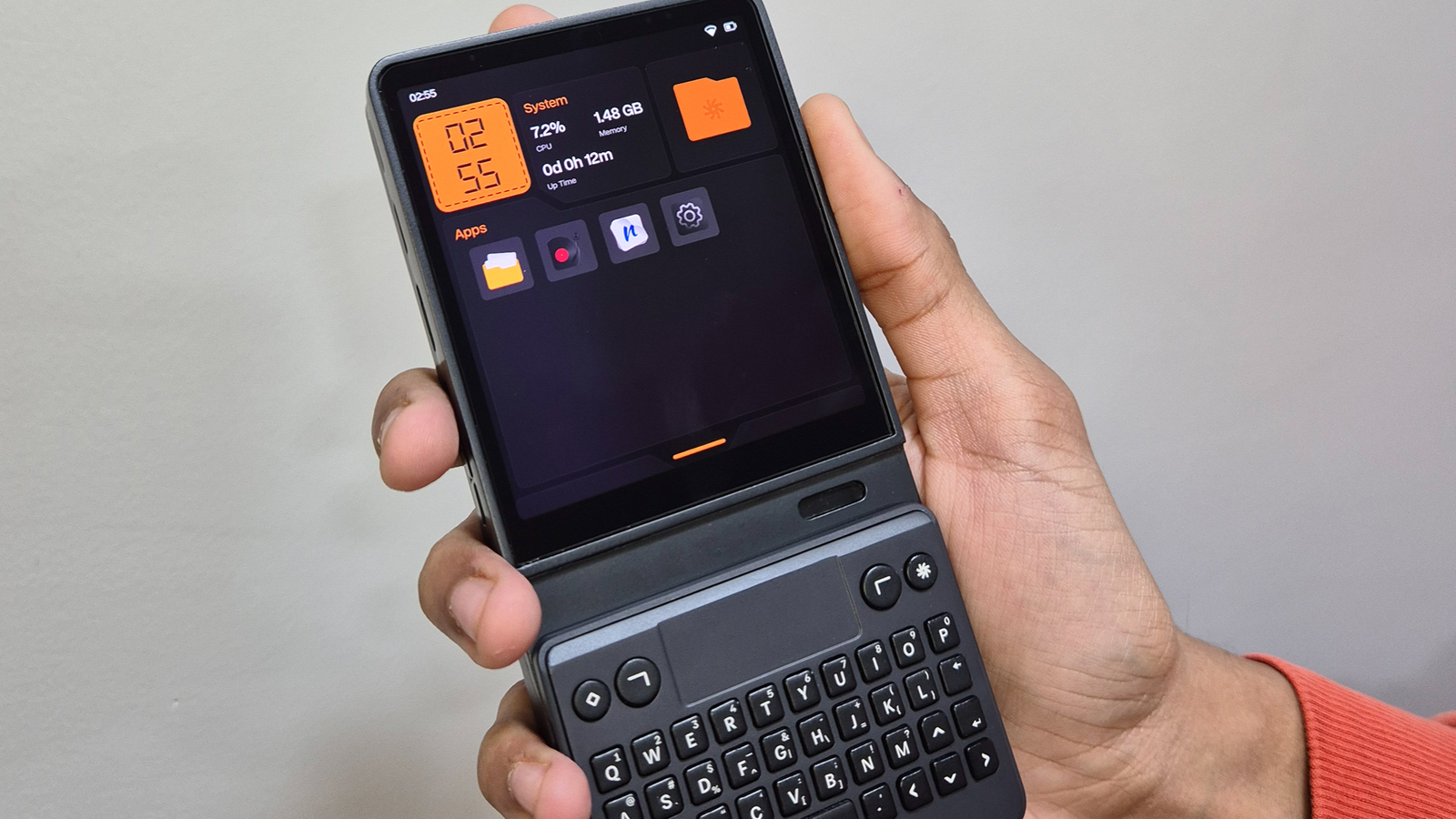
The Comet is a handheld Linux-phone hybrid from Mecha Systems.However, unlike a typical modern-day smartphone, only the top half of the device is a screen—a 3.9-inch 1080p AMOLED display, similar in size to the cover display on the Samsung Galaxy Z Flip.The bottom half houses a 40-pin pogo connector that allows you to snap on different extensions.
At launch, Mecha is shipping three extension modules: A QWERTY keyboard with a pointing stick and RGB-backlit keys running ZMK firmware.A gamepad with a D-pad, an analog stick, shoulder buttons, and a second pointing stick for camera control—plus its own USB-C port, so you can use it detached from the Comet or pair several of them for multiplayer.A GPIO breakout board with a serial console and CAN bus.
All three extensions are open hardware, and Mecha publishes the pin diagrams and design files so you can build your own, too.As for the overall build, it weighs roughly 225 grams and measures 73 x 155 x 14mm.It should slide into most pockets unless you wear ultra-tight jeans.
For comparison, the iPhone 17 Pro Max measures 78 x 163.4 x 8.8mm and weighs 233 grams.I should also mention that it’s not thick because of bad design—in fact, the extra space is properly utilized.The left side houses a USB-C 3.0 host port and a USB-C 2.0 port that doubles as a display output, rated for 2K at 60Hz.
You can also find a 3.5mm headphone jack.There’s also a USB-C 3.0 port on the bottom that supports PD charging and OTG.Related 5 things you can do with your Android phone’s USB port (besides charging) Charging is just the tip of the USB iceberg.
Posts 5 By Ismar Hrnjicevic The back panel is also removable.The top half conceals three kill switches for Wi-Fi, the mic, and the 8MP camera, while the bottom half hides a removable 4,100mAh LiPo battery, with the SIM tray sitting underneath it—like good ol’ phones from the 2000s.I should also mention that you don’t necessarily have to use the battery; it can power on over USB PD without one.
Overall, you’re getting the same I/O you’d expect from a computer in a smartphone-like form factor, complete with modular input devices—and it’s running Linux under the hood.For me, that’s the most innovative gadget I’ve seen in the Linux hardware space in a long time.You can check out the full spec sheet here.
Related The 5 modular Android smartphones we all wanted (but never bought) The floundering promise of modularity.Posts 1 By Goran Damnjanovic But, what can you do with the Mecha Comet? Are you supposed to use it like a phone? Or a computer? Before I get to the use cases, let me quickly highlight the silicon powering the device.The Mecha Comet comes in two variants: The base model runs an NXP i.MX 8M Plus with four ARM Cortex-A53 cores at 1.8 GHz, a Vivante GC7000UL GPU, and a 2.3 TOPS NPU for on-device machine learning.
The pricier model steps up to the i.MX 95, which has six Cortex-A55 cores, also at 1.8 GHz, along with an ARM Mali-G310 GPU and a much beefier 8 TOPS NPU.Both models let you choose between 4GB or 8GB of RAM and 64GB or 128GB of eMMC storage.You can expand that later with a microSD card or an NVMe SSD.
In terms of performance, it’s roughly in entry-level smartphone territory—but then again, it really isn’t about power.It’s about flexibility.It’s powerful enough to run most Linux terminal apps, which opens up a lot of possibilities.
You’re also getting an NPU built right into the SoC, which opens up the possibility for on-device AI workflows—something not possible in budget smartphones.Now, I personally plan to use it for SSHing into my main computer and home lab and operating them remotely.That’s also why I’ll be putting the LTE modem in the M.2 slot rather than an SSD—mobile data means I can reach my machines even when there’s no Wi-Fi around.
There’s only one M.2 slot, so it’s either the NVMe SSD or the LTE modem—not both.And yes, as you might expect, the LTE modem is modular.You can swap it out for different ones if you like.
The Mecha Comet currently only offers a Cat 6 4G modem.5G is planned for future revisions.I also showed it to my partner, and she sees this as the ideal minimalist phone for digital detoxing.
There’s a built-in media player, a basic notes app, and you can even run Spotify from the terminal if you want.That said, using it as a dedicated phone is a bit trickier.There’s no dedicated earpiece, so you’d have to take calls over the 3.5mm jack or with Bluetooth earbuds.
But then again, we mostly send messages instead of taking calls—and there are CLI tools for WhatsApp as well.The cooler technical use cases come from the 40-pin I/O connector, which you get via the breakout extension.It exposes two I2C interfaces, two UARTs, SPI, four ADC channels, and PWM.
You could genuinely use this as the brain of a robotics project.You can also treat the Comet as a platform rather than the end project and build something entirely your own on top of it—it’s open hardware, after all.Related 5 fun nerdy hobbies that you can start doing for cheap right now Making and doing shouldn't cost the earth.
Posts By Tim Brookes The Mecha Comet is rethinking the Linux phone Not slapping a Linux distro into a smartphone chassis and calling it a day If you’ve been in the Linux space for any length of time, you know the community has been trying to make a Linux phone happen for years now.There have been manufacturers building the hardware and distros developing touch interfaces for it, but it has never really taken off.Now, I personally think this is because every attempt has been about framing Linux as —you can do everything you do on your iPhone or Android phone, except it’s Linux.
The moment you frame it that way, you’ve given up all your actual advantages and agreed to play someone else’s game on their terms.You’re never going to win that one.The Mecha Comet doesn’t play that game.
It’s leaning into the core benefits of Linux and open source.It’s shipping a proper Linux terminal that you can carry with you, with access to its own mobile data.And while I haven’t gone hands-on with the device, I do think it’s going to have excellent battery life since you’re pairing a fairly large 4,100mAh battery with a less power-hungry chip and a small 3.9-inch display.
The keyboard extension is also a big part of why I’m particularly optimistic about it.Sure, you can get a Linux terminal on your Android phone, but typing commands on a virtual keyboard is an absolute nightmare.Having a physical keyboard changes that completely.
Related The 4 Best Android Phone Brands for Linux Lovers Because it's hard to daily a Librem 5.Posts 2 By Bertel King Do you want a Linux terminal in your pocket? The best elevator pitch I can come up with for the Mecha Comet is that it’s like having a dedicated Linux terminal in your pocket.If that immediately floods your mind with a bunch of use cases and brings a spark to your eyes, then this device was made for you.
At the time of writing, the Mecha Comet is available for pre-order.Shipping is expected around October 2026 or possibly November 2026.
Read More