Genesis unveiled its first full-size flagship SUV, the GV90, on Aug.19 at the Palace of Fine Arts in San Francisco.It's the production version of the Neolun concept the brand revealed in 2024.
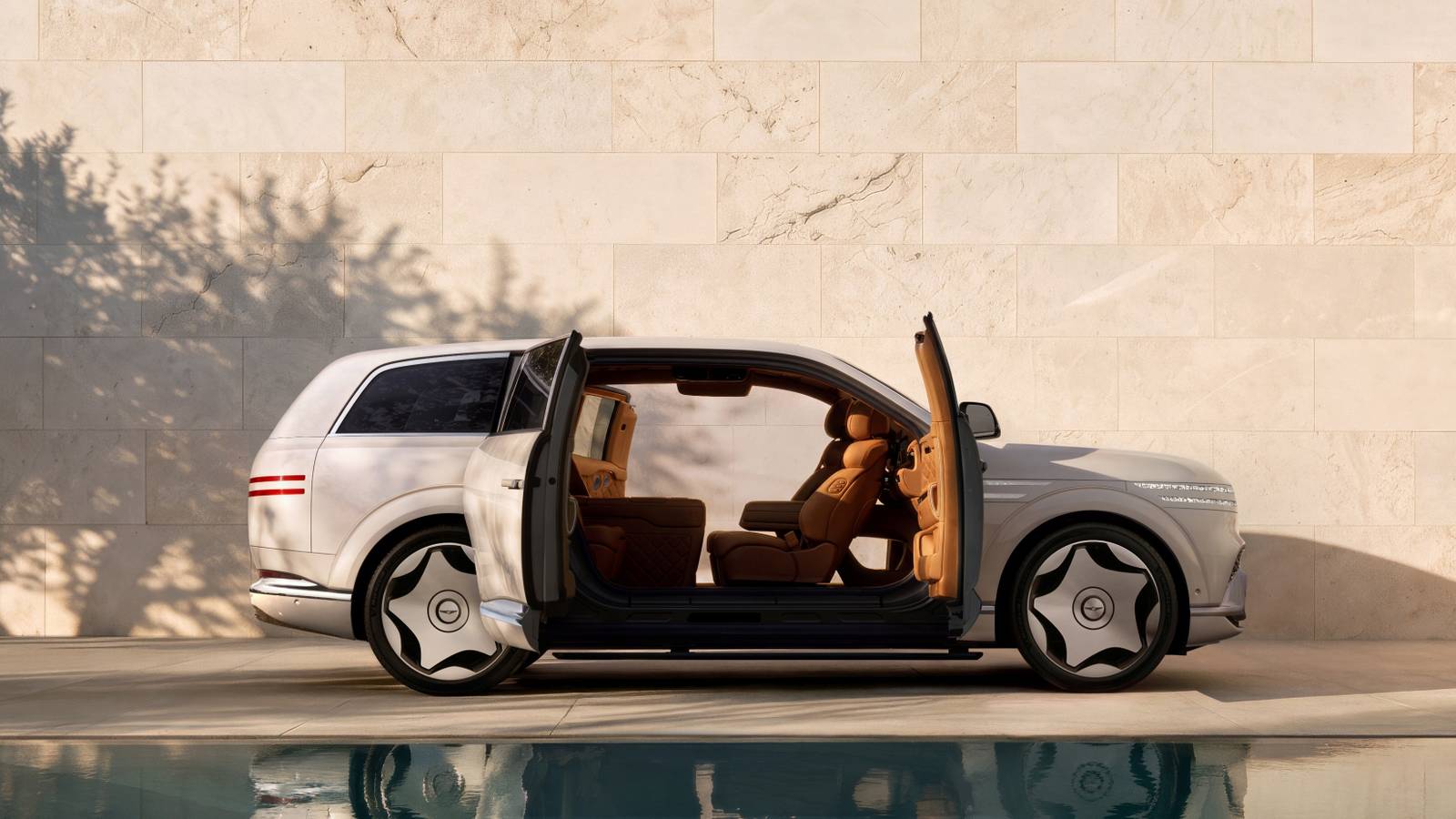
The forthcoming SUV comes in two variants, a standard GV90 and a Neolun version with doors that open and close on their own.The automaker said those doors, along with an airbag that covers the entire roof glass in a rollover, are world firsts.The GV90 also debuts an onboard AI built to run the vehicle, not just answer questions about it, as if it were only a digital owner's manual.
Genesis is still a young brand by luxury standards, having only launched in 2015, but its growth has been rapid.It reached one million global sales in less than eight years, making it one of the auto industry's fastest-growing and most respected brands.The GV90 marks the brand's first entry into the full-size SUV segment, built on a new eMP platform the automaker said is reserved specifically for its flagship models.
An AI built to run the GV90 Download third-party apps to the dashboard The AI inside the GV90 is called Gleo AI, a generative AI agent occupants can use to control various vehicle functions.According to Hyundai Motor Group, it's a voice-recognition system meant for "intelligent vehicle control," letting occupants adjust settings and pull up information through natural conversation instead of digging through menus.Gleo AI runs on top of Pleos Connect, Hyundai Motor Group's new infotainment platform built on Android Automotive OS.
The company says Pleos Connect will reach more than 20 million vehicles across its brands by 2030, with the GV90 among the first Genesis models to use it.The platform also opens the door to a broader app ecosystem.Because it runs on Android Automotive OS rather than mirroring a phone, Pleos Connect can download third-party apps directly to the GV90's infotainment system through what Genesis calls the Pleos App Market, much like a smart TV downloads apps instead of streaming them from a connected phone.
For now, Genesis describes Gleo AI in general terms and broad strokes, but its integration into the GV90 shows what's possible as vehicles trend toward running more of their features through software, with AI standing in for buttons and menus.Related This Genesis SUV beats Lexus at its own game: durability, luxury, and value This Korean luxury SUV is rewriting expectations around reliability.Posts By Tyler Dupont No B-pillar required Doors that open themselves, engineered around a missing pillar Close The GV90 Neolun's signature feature is a set of doors Genesis calls the Neolun Arch Gate.
They're coach doors built without a B-pillar, opening and closing independently, a world first according to the automaker.Every vehicle normally needs a B-pillar, the vertical support between the front and rear doors, for structural rigidity and side-impact protection.Removing it usually means giving something up elsewhere in the design, namely safety.
Without a B-pillar to anchor a conventional hinge, the rear door needed a different way to swing open clear of the front one.The fix, according to Genesis, is a dual-motion hinge on the rear doors.The door first slides slightly outward, then rotates open, clearing the front door without a pillar to anchor it in place.
With both doors open, they face each other, creating a wide, unobstructed opening for entry and exit.To make up for the missing pillar regarding crash protection, Genesis reinforced the GV90's surrounding body.The B-pillar normally does two jobs.
It holds up the roof and keeps it from caving in during a rollover, while acting as the main barrier against cabin intrusion during a side-impact crash.High-strength dual steel beams take over that role on the GV90, spreading crash forces through the surrounding frame instead of a single vertical post.The automaker also built a hidden roll cage into the surrounding structure, a frame that's 1.5 times thicker than what's used in conventional vehicles, reinforced with high-strength steel tubes and structural foam.
According to Genesis, it performs the same in a crash as a vehicle that still has its B-pillar in place, though that's the automaker's claim, not an independently verified test result.Performance, cabin, and design details The forthcoming GV90 rides on a new eMP platform built exclusively for Genesis flagship models, with combined output from the front and rear motors reaching 657 horsepower and 590 lb-ft of torque.Powering the GV90 is a 123.5-kilowatt-hour battery, the largest Hyundai Motor Group has used in an EV to date, giving the seven-seat version an estimated range of about 310 miles based on internal testing from Genesis.
It can charge from 10% to 80% in 22 minutes on a 350-kilowatt fast charger.Meanwhile, an active rear-wheel steering system, which turns up to five degrees, tightens the larger GV90's turning radius to roughly that of a mid-size car.Outside, the design draws from the rounded silhouette of a traditional Korean moon jar, with laser-engraved headlamps, 24-inch forged wheels, and a choice of 16 exterior colors.
Inside, a pop-up OLED display grows from 23.6 inches while driving to 24.6 inches when the SUV is parked, and a 25-inch heads-up display replaces the traditional gauge cluster.The optional Bang & Olufsen sound system comprises 25 speakers with Dolby Atmos, including a mode built to recreate the acoustics of venues like Boston Symphony Hall.The GV90 lineup starts with the standard SUV, then the GV90 Neolun, distinguished by its Neolun Arch Gate doors.
Genesis is also offering a limited-run GV90 Neolun First Edition, with exclusive two-tone color combinations and cashmere trim, for buyers who want the most exclusive version of an already exclusive vehicle.As of this writing, however, Genesis hasn't announced U.S.pricing or an on-sale date for any of them.
Read More