SSDs have gotten faster, but hard drives, for better or worse, haven't.There's a reason why they haven't, and that's mostly due to to the way they work.So any attempts to make hard drives faster would need to get around that.
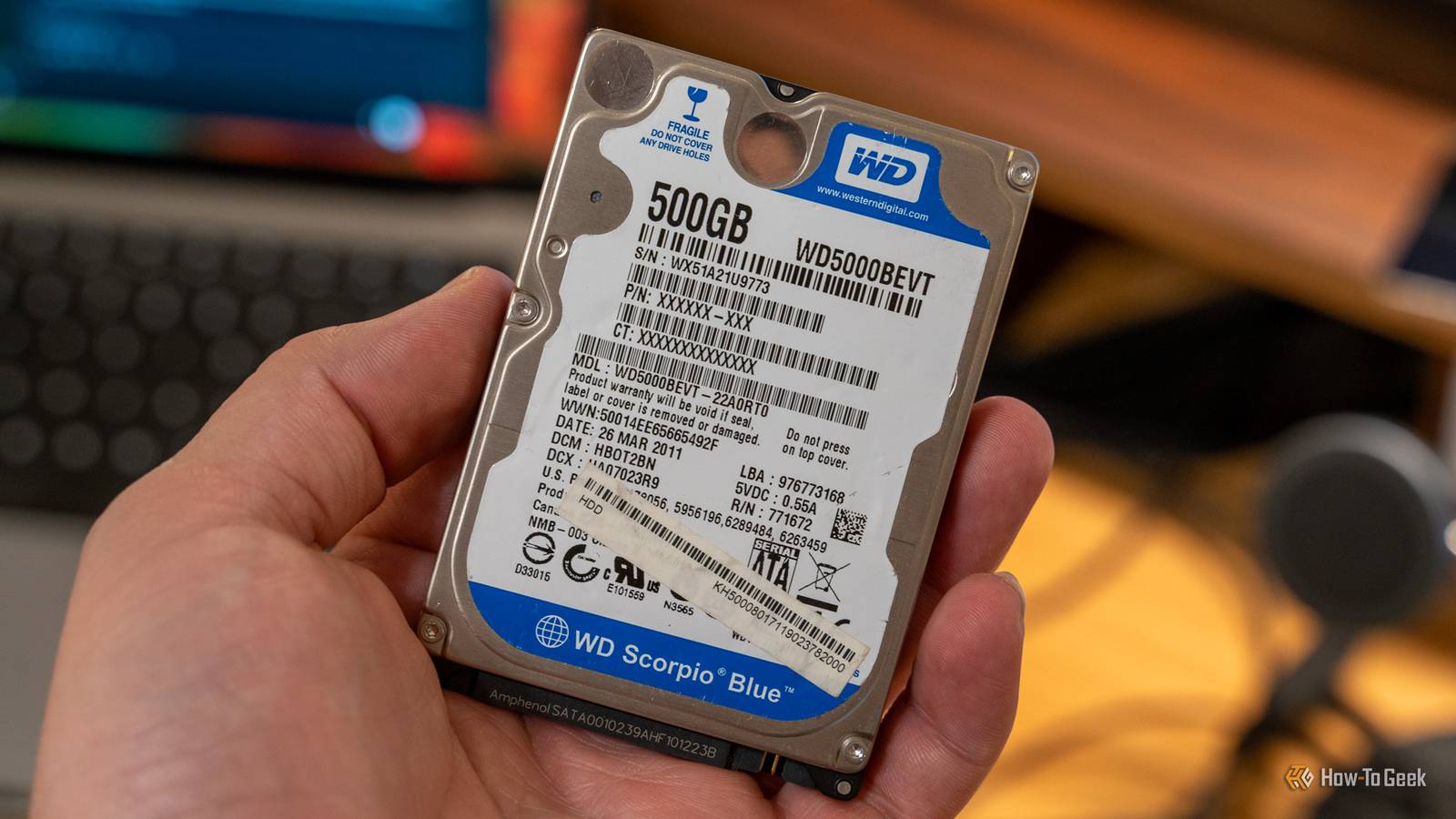
Enter dual-actuator drives—a crazy idea that never really took off for many reasons.What are dual-actuator hard drives? Two arms double the read speed A conventional hard disk drive consists of a stack of spinning magnetic platters and a single mechanical arm, known as an actuator, which moves the read and write heads across the surfaces of these platters.No matter how much data is stored on the drive or how many platters are stacked inside the casing, that single actuator arm can only be in one physical location at any given microsecond.
Consequently, all data requests must form a queue and be processed sequentially.So a dual-actuator hard drive gets around this by introducing a second, fully independent actuator arm into the same physical enclosure.Typically, the platters are logically divided into an upper half and a lower half.
One actuator controls the read and write heads for the top set of platters, while the second actuator independently handles the bottom set.Related SATA SSDs aren’t dead—this is where they still beat NVMe drives Practical strategies for repurposing SATA SSDs as fast external drives and bulk storage on a budget.Posts By Sydney Butler By operating concurrently, these two arms effectively double the drive's sequential throughput and its input/output operations per second (IOPS).
To the host computer system, a single dual-actuator drive often appears as two separate logical storage volumes, allowing parallel data streams to be processed simultaneously.Seagate pioneered this commercial effort with its Mach.2 technology, looking to deliver sequential read and write speeds that rival older SATA solid-state drives while maintaining the massive storage capacities characteristic of mechanical hard drives.You can think of this as the mechanical storage equivalent of adding a second core to a single-core computer processor, splitting the physical workload to mitigate the physical bottlenecks inherent in moving parts.
Why haven't they taken off? A poor alternative to SSDs and an expensive alternative to HDDs Close The performance benefits over traditional mechanical drives are undeniable, but dual-actuator hard drives have not achieved widespread market penetration for several compounding technical and economic reasons.The primary deterrent is the relentless advancement and decreasing cost of SSDs.Over the last decade, flash-based storage has reached price points that make it highly accessible for both consumers and enterprise environments.
SSDs contain no moving parts and offer speeds that are orders of magnitude faster than even the best dual-actuator mechanical drive.Those looking for performance simply purchase SSDs, while those seeking the absolute lowest cost per terabyte for cold bulk storage opt for standard, single-actuator hard drives.Dual-actuator drives occupy an awkward middle ground in this tiered storage hierarchy, offering neither the blistering speed of flash memory nor the rock-bottom manufacturing cost of traditional mechanical drives.
Furthermore, adding a second mechanical arm introduces significant engineering complexities.It increases the drive's overall power consumption, generates more physical vibration inside the server chassis, and requires a higher degree of precision manufacturing.These factors inevitably drive up the bill of materials, making the drives substantially more expensive to produce and purchase.
There is also a software hurdle to consider.The drive often presents itself as two separate logical units to maximize performance, and legacy hardware controllers and software-defined storage solutions require updates and optimizations to properly balance workloads across the two actuators.If a data center's infrastructure is not explicitly optimized to distribute data concurrently to both halves of the drive, the secondary actuator sits idle, entirely negating the premium paid for the technology.
This combination of an expanding SSD market, increased manufacturing costs, and the necessity for infrastructure overhauls has kept them highly specialized.Do dual-actuator drives have a reason to exist? In data centers? Yes.But not at home Sadly, in the consumer desktop, laptop, and general enterprise spaces, the technology will likely never see the light of day.
Flash storage has permanently conquered these sectors, and traditional hard drives are rapidly becoming legacy hardware for everyday computing tasks.And we're too late to consider this.However, the trajectory is vastly different within the hyper-scale sector, specifically among massive cloud service providers and colossal data centers.
For these infrastructure titans, dual-actuator technology is not just a passing curiosity; it is rapidly becoming an unavoidable mechanical necessity.As hard drive manufacturers utilize advanced recording technologies like Heat-Assisted Magnetic Recording (HAMR) to push drive capacities beyond thirty and eventually fifty terabytes, a critical mathematical problem emerges.The ratio of raw storage capacity to mechanical throughput becomes catastrophically unbalanced.
If a massive hard drive with a single actuator fails in a data center array, rebuilding that drive from parity data could take weeks due to the physical speed limits of a single mechanical arm.This prolonged rebuild window leaves the entire storage array dangerously vulnerable to a secondary drive failure and subsequent data loss.To maintain acceptable service level agreements and rapid rebuild times, the drive's IOPS per terabyte must remain steady as storage capacities scale upward.
Therefore, dual actuators will effectively become mandatory for ultra-high-capacity enterprise drives in the near future.They will become the standard for nearline cloud storage, operating invisibly behind the scenes to keep the modern internet functioning efficiently.Quiz 8 Questions · Test Your KnowledgeWeird and quirky storage drivesTrivia challengeFrom hybrid SSHDs to bizarre form factors — how well do you really know the oddest corners of storage technology?Hybrid DrivesForm FactorsHistoryHardwareOdditiesBegin 01 / 8Hybrid DrivesWhat does the acronym SSHD stand for in the context of hybrid storage drives?ASolid State Hard DriveBSolid State Hybrid DriveCSequential Storage High-DensityDStatic Spinning Hard DiskCorrect! SSHD stands for Solid State Hybrid Drive.
These drives combine a traditional spinning hard disk with a small amount of NAND flash memory to accelerate frequently accessed data, giving users a middle ground between HDD capacity and SSD-like speed.Not quite — SSHD stands for Solid State Hybrid Drive.While 'Solid State Hard Drive' sounds convincing, it's actually a common misconception.The 'hybrid' part is key, since these drives merge both spinning magnetic platters and flash memory into a single unit.Continue 02 / 8HistoryWhich company is widely credited with popularizing the consumer SSHD by releasing the Momentus XT in 2010?AWestern DigitalBToshibaCSeagateDSamsungCorrect! Seagate's Momentus XT was a landmark product that brought the SSHD concept to mainstream consumers.
It combined a 500GB spinning platter with 4GB of SLC NAND flash and used adaptive memory technology to learn which data to cache for faster access.Not quite — it was Seagate that popularized the consumer SSHD with its Momentus XT in 2010.The drive used a modest 4GB of SLC NAND flash alongside a traditional 500GB platter, and it was groundbreaking enough to turn many heads in the enthusiast storage community.Continue 03 / 8OdditiesWhat was unusual about the Intel Optane Memory H10, released in 2019?AIt combined a 3D XPoint Optane cache with a QLC NAND SSD on a single M.2 cardBIt used a spinning platter alongside Optane memory in a 2.5-inch chassisCIt was the first drive to use PCIe 5.0 alongside SATA flash storageDIt embedded Optane memory directly into a USB thumb drive casingCorrect! The Intel Optane Memory H10 crammed both 3D XPoint Optane cache and QLC NAND storage onto a single M.2 2280 card.This meant the Optane portion acted as a super-fast buffer for the slower QLC NAND, all within one slot — a genuinely clever hybrid approach for thin laptops.Not quite.
The Intel Optane Memory H10 was unusual because it placed 3D XPoint Optane cache and QLC NAND SSD storage together on one M.2 card.This dual-storage-on-one-stick design was highly unconventional and required special Intel RST drivers to function correctly, making it a quirky product indeed.Continue 04 / 8Form FactorsThe Sony Microvault and similar tiny USB drives once came in novelty shapes like food items and cartoon characters.What is the technical term for this category of novelty drives?APromotional flash drivesBSwag drivesCDesigner USBsDCustom-molded drivesCorrect! The industry term most commonly used is 'promotional flash drives.' They are widely produced as branded giveaways and collectibles, molded into virtually any shape imaginable — from sushi rolls to rubber ducks.
Some rare novelty drives have become genuine collector's items over the years.Not quite — the most widely recognized industry term for novelty-shaped USB drives is 'promotional flash drives.' These quirky drives are manufactured in bulk for marketing campaigns and giveaways, and the moldable casings mean manufacturers have produced everything from mini pizza slices to tiny LEGO-style bricks.Continue 05 / 8HardwareApple's Fusion Drive, introduced in 2012, is a type of hybrid storage.How does it differ from a traditional SSHD?AIt uses proprietary Apple flash chips soldered directly to the HDD circuit boardBIt combines a separate SSD and HDD into a single logical volume managed by softwareCIt is a single physical unit with flash embedded in the same enclosure as the platterDIt caches only the operating system boot files using a dedicated firmware controllerCorrect! Apple's Fusion Drive is two separate physical drives — an SSD and an HDD — that macOS presents as a single unified volume using Core Storage (later APFS).Unlike an SSHD where everything is in one enclosure, Fusion Drive relies entirely on software-level management to decide what lives on the flash and what goes on the platter.Not quite.
The key difference is that Apple's Fusion Drive consists of two separate physical drives — an SSD and an HDD — merged into one logical volume by macOS software.A traditional SSHD is a single self-contained unit with its own firmware controller managing the flash cache, making them architecturally quite different despite achieving similar goals.Continue 06 / 8OdditiesWhat was the primary purpose of the Robson cache technology Intel developed before eventually pivoting toward SSDs?ATo use a small NAND chip on the motherboard to accelerate hard drive performanceBTo embed flash memory inside RAM DIMMs for faster boot timesCTo create a PCIe-attached SSD that could cache optical disc dataDTo use CPU-integrated storage for caching OS page filesCorrect! Intel's Robson technology — which became Intel Turbo Memory — placed a small NAND flash cache on a mini-PCIe card inside laptops to speed up hard drive access.It worked alongside Windows ReadyBoost and ReadyDrive but was largely underwhelming in real-world performance, and the project was quietly shelved as SSDs took over.Not quite.
Intel's Robson/Turbo Memory technology used a small NAND flash chip on a mini-PCIe card to cache hard drive data on laptops.It leveraged Windows Vista's ReadyBoost and ReadyDrive features but never lived up to the hype, and it was eventually abandoned as standalone SSDs became cheaper and far more effective.Continue 07 / 8HistoryThe iomega Zip drive was a popular removable storage medium in the late 1990s.What was the original storage capacity of the first Zip disks released in 1994?A250MBB100MBC750MBD50MBCorrect! The original Iomega Zip disk launched in 1994 with a 100MB capacity, which was enormous compared to the 1.44MB floppy disks it aimed to replace.
Later iterations pushed capacity to 250MB and even 750MB, but the original 100MB version was the one that captured the imagination of consumers and creative professionals alike.Not quite — the first Iomega Zip disks released in 1994 held 100MB, a staggering amount at the time when standard floppy disks only held 1.44MB.Later versions expanded to 250MB and 750MB, but it was that original 100MB capacity that made the Zip drive a cultural phenomenon in offices and design studios throughout the late 1990s.Continue 08 / 8HardwareWestern Digital's Black² drive was a quirky dual-drive product released around 2013.What made it so unusual?AIt contained both a 120GB SSD and a 1TB HDD in a single standard 2.5-inch form factorBIt used dual spinning platters rotating in opposite directions to reduce vibrationCIt featured two separate SATA connectors, one for flash and one for the platterDIt combined SSD storage with a built-in PCIe controller on a 2.5-inch boardCorrect! Western Digital's Black² squeezed a 120GB SSD and a full 1TB HDD into a single 2.5-inch, 9.5mm-thick drive — the same size as a standard laptop hard drive.
The catch was that it required special WD software to unlock the HDD portion, and it appeared as two separate drives to the operating system rather than one seamless volume.Not quite — the Western Digital Black² was remarkable because it packed a 120GB SSD and a 1TB HDD into one standard 2.5-inch laptop-sized enclosure.Unusually, users had to install WD's own software to unlock and access the HDD portion, and the two storage sections appeared as separate drives rather than being merged transparently like Apple's Fusion Drive.See My Score Challenge CompleteYour Score/ 8Thanks for playing!Try Again You may never see a dual-actuator drive in person While they will never be unboxed by a typical computer user, dual-actuator drives are absolutely destined to become the foundational workhorses of the future global data center infrastructure.That's where the cost, benefits, and trade-offs make the most sense.
Read More