I used to be a Synology die-hard fan, but that's recently changed.While I think Synology still makes a solid NAS, they're no longer the best option around, and my favorite NAS brand might just surprise you.Synology used to be the king of the castle Once an industry leader, now just another brand Synology has been around for over 25 years at this point, and their dominance in the NAS market definitely shows.
They started making network attached storage systems well before most people even knew what a NAS was.This definitely gives Synology a leg up on the competition, and is what makes them an industry leader today.If you were to ask me even six months ago what the best NAS to buy was, I would have said a Synology.
Synology's dominance doesn't just come from the hardware side of things.In fact, it primarily has nothing to do with their hardware and everything to do with their software.Synology's Disk Station Manager, or DSM, is its secret sauce.
DSM has to be, even to this day, one of the simplest and easiest to use NAS operating systems I've ever used.DSM is actually the reason I would recommend someone buy a Synology today.Outside of DSM, there's really no other reason to buy a Synology.
Quiz8 Questions · Test Your KnowledgeNAS brands and ecosystemsTrivia challengeSynology, Ugreen, Terramaster, and more — how well do you actually know the boxes storing everyone's data?BrandsHardwareSoftwareStorageHistoryBegin01 / 8BrandsSynology is headquartered in which country?ASouth KoreaBJapanCTaiwanDChinaCorrect! Synology was founded in Taipei, Taiwan in 2000 and remains headquartered there today.Taiwan is also home to several other major storage and networking companies, making it a hub for this kind of hardware.Not quite — Synology is based in Taiwan, not to be confused with mainland Chinese brands like Ugreen or Hikvision's storage division.Taiwan has a long history of producing some of the world's most influential storage and networking hardware companies.Continue02 / 8SoftwareWhat is the name of Synology's operating system that runs on its NAS devices?ATOSBDSMCQTSDNASmanThat's right — DSM stands for DiskStation Manager, and it's widely considered one of the most polished NAS operating systems available.
It runs on a Linux base and gets regular major updates that add features and security patches.Close guess, but the answer is DSM — DiskStation Manager.QTS is actually QNAP's operating system, which is a common mix-up.TOS belongs to Terramaster, so the NAS world does love a good three-letter acronym.Continue03 / 8BrandsUgreen, which expanded aggressively into the NAS market around 2024, is primarily known for making what type of products?AGaming peripheralsBSmart home devicesCCables and charging accessoriesDWireless routersExactly right! Ugreen built its reputation and a massive customer base selling USB hubs, cables, and chargers before pivoting into NAS hardware.
That accessory background means they're often praised for build quality and thoughtful design touches.Actually, Ugreen's roots are in cables and charging accessories — USB hubs, chargers, and adapters.Their NAS lineup, branded as NASync, was a bold move into a market they had no prior presence in, which made their competitive pricing and specs all the more surprising.Continue04 / 8HistoryQNAP, one of the oldest dedicated NAS manufacturers, was founded in which year?A1998B2004C2010D2001Spot on — QNAP was founded in 2004, the same year Synology released its first product.The two companies have been fierce competitors ever since, each pushing the other to innovate across both hardware and software.QNAP was actually founded in 2004, which puts it in the same founding era as rival Synology.
Their parallel histories have led to decades of healthy competition that has genuinely benefited consumers with better features and more reasonable pricing.Continue05 / 8HardwareWhat does the 'RAID 5' configuration require as a minimum number of drives?A2B4C3D5Correct! RAID 5 needs at least 3 drives to work, using distributed parity across all disks so that any single drive can fail without data loss.It's one of the most popular NAS configurations because it balances storage efficiency with redundancy.RAID 5 actually requires a minimum of 3 drives.It's a common point of confusion since the number in the RAID name doesn't indicate the drive count.
With 3 drives you get the capacity of 2 drives plus the fault tolerance of losing one drive without losing any data.Continue06 / 8SoftwareTerramaster's NAS operating system is called TOS.What does TOS stand for in this context?ATerramaster Operating SystemBTerrestrial Open SystemCTotal Object StorageDTerramaster Online SuiteRight! TOS simply stands for TerraMaster Operating System.It's a straightforward name compared to the acronym creativity of some competitors.
TOS has improved significantly over the years but is still generally considered less mature than Synology's DSM.The answer is TerraMaster Operating System — TOS keeps it pretty literal.While it lacks the brand flair of some competitor names, TOS has steadily improved over several major versions and is now a reasonable choice for budget-conscious NAS buyers who don't need the full ecosystem of a Synology.Continue07 / 8BrandsWhich NAS brand is owned by the same parent company as the surveillance camera giant Hikvision?AAsustorBTerramasterCDahuaDEzvizCorrect — Dahua Technology is a sibling company to Hikvision under shared Chinese state-connected ownership.Both companies have faced scrutiny and trade restrictions in several Western countries due to security concerns, which is worth knowing before buying storage hardware.The answer is Dahua.
Both Dahua and Hikvision operate under closely related ownership structures with ties to the Chinese government, and both have appeared on US trade restriction lists.It's a good reminder that knowing who actually makes your storage hardware matters.Continue08 / 8StorageIn NAS terminology, what is a 'hot spare' drive?AA drive kept warm in a separate enclosure for faster read speedsBAn idle drive installed in the NAS that automatically rebuilds the array if another drive failsCA secondary drive used only for scheduled backupsDA drive formatted with a special heat-resistant file systemExactly right! A hot spare sits dormant in the NAS enclosure but springs into action automatically the moment the system detects a drive failure, beginning the rebuild process without any human intervention.It's a great safety net for people who don't monitor their NAS closely.A hot spare is actually an idle standby drive that automatically takes over and begins rebuilding the RAID array the moment another drive fails — no human action needed.
It's one of those features that sounds optional until the one time you really need it and aren't around to respond quickly.See My ScoreChallenge CompleteYour Score/ 8Thanks for playing!Try Again Ugreen surprised everyone What started out as a charger company has become so much more When I first saw that Ugreen was making network attached storage systems, I was quite skeptical.Ugreen started out as a charger company, and that's all I thought of them as.However, in 2026, Ugreen makes much more than just chargers.
Ugreen's NAS lineup is the most interesting addition to the brand's products though.They started pushing the NAS systems in 2024, so the entire lineup is under two years old at this point.While being relatively new, Ugreen has become a dominant force in the NAS world.
Synology has tried to position itself as the Apple of the NAS world with pricing to match.Synology also did a really dumb thing last year and tried to limit people from using third-party hard drives in their NAS systems.This put Ugreen in the perfect position to take over the NAS world—and take over they did.
Ugreen's UGOS platform is almost as easy to use as Synology's is at this point.UGOS has a simple to use app store, full Docker support, and an interface that I wouldn't mind telling even non-techy people to use.Really, I'd say it's just as easy, only missing a few key features that I still like from Synology, like SHR.
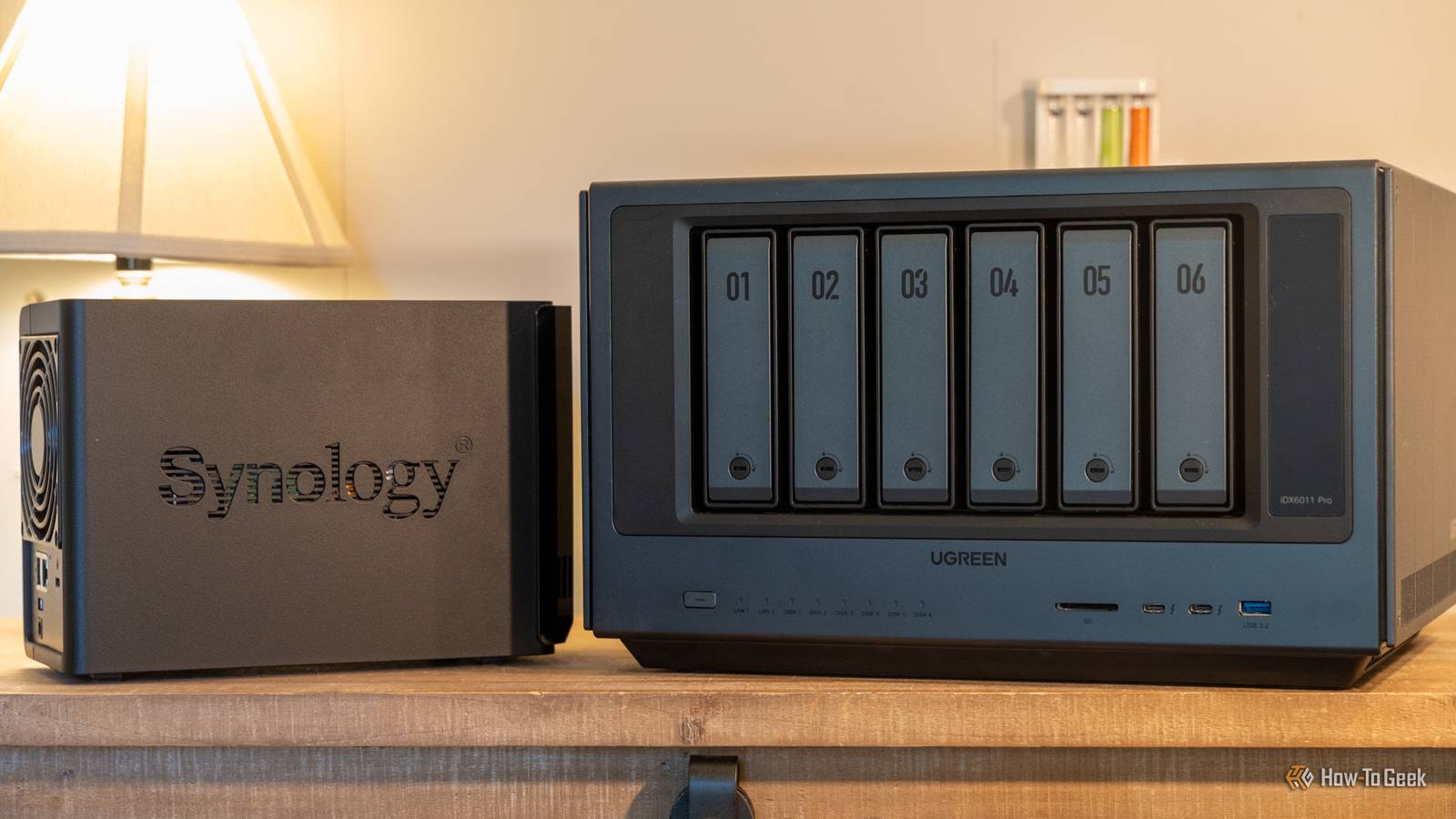
Synology's hybrid RAID aside, Ugreen's NAS systems really have impressed me recently.I've got their highest-end system in my homelab right now, which admittedly is pretty expensive.But, the hardware the iDX6011 Pro offers is leaps and bounds above that Synology's similarly priced models bring to the table.
In fact, Synology doesn't really even have a comparable NAS to stack against Ugreen's iDX6011 Pro.Synology's DS1823xs+ is three years old at this point, and sports an AMD Ryzen V1780B with only 8GB of RAM stock, while maxing out at 32GB.The Ugreen iDX6011 Pro features an Intel Core Ultra 7 255H with 64GB of RAM, something you have to pay several thousand to get from Synology.
Ugreen's hardware is also just as good, if not better, then Synology.I've used multiple Synology NAS systems over the years, and my Ugreen is built more solid than any Synology I've come in contact with.The drive trays are simple to use, and the rest of the hardware is superb.
As another example, Synology doesn't sell a single NAS in their consumer line that has built-in 10GbE networking.Meanwhile, Ugreen has several models with 10GbE built-in, with 2GbE as a fallback.Synology stopped innovating, so others are picking up the mantle Ugreen is simply a better buy than Synology at this point There's really little reason to look at Synology at this point unless you're specifically wanting Disk Station Manager as an operating system.
Synology still makes NAS systems, but they're leaving a lot on the table.Take the recently-released Synology DS225+ as an example.It packs a now-discontinued 2019-era Intel Celeron J4125 processor and just 2GB of RAM, which can expand to 6GB of RAM.
Compare that to the Ugreen DXP2800, which costs about $50 more, and you'll see where Ugreen shines.The DXP2800 packs an Intel N100 processor, which is four years newer then the J4125 in the DS225+, and it also comes with 8GB of RAM built-in (but no way to expand it).The DXP2800 also features NVMe drive support, something that the DS225+ simply doesn't have.
Really, Synology has stopped innovating at this point.They're just doing minor spec bumps to their NAS systems and hoping people still buy into the ecosystem.I really hope Synology changes course here, but it doesn't seem like that's likely right now.
UGREEN NASync DXP2800 Brand UGREEN CPU Intel 12th Gen N-Series Memory 8GB (Upgradeable to 16GB) Drive Bays 2 x 22TB Ports 2.5GbE, USB-C, USB-A (x3) Caching Expandable up to 8TB This cutting-edge network-attached storage device transforms how you store and access data via smartphones, laptops, tablets, and TVs anywhere with network access.See at Amazon Expand Collapse Ugreen iDX 6011 Pro AI NAS Brand UGREEN CPU Intel Core Ultra 7 255H Memory 64GB LPDDR5/x Drive Bays 6 Expansion OCuLink Ports Thunderbolt 4, USB3, USB2, HDMI, SD The Ugreen iDX 6011 Pro AI NAS is one of the most powerful NAS servers in the Ugreen lineup.With Intel's Core Ultra 7 255H 16-core processor and 64GB of LPDDR5/x RAM onboard, there's more than enough power to handle anything you can throw at this system.
Add to that dual Thunderbolt 4 ports, dual 10GbE LAN ports, an OCuLink expansion port, and more, and you have a very solid network attached storage system.$2599 at Ugreen Expand Collapse I still love Synology, but it's getting harder to recommend them over the competition I have a good friend who runs a photography business, and she needs a NAS for her photo backups.I originally recommended that she go with a Synology, but that's now changed to where I will be recommending she go with a Ugreen NAS instead.
Ugreen's NAS lineup is simply more powerful than Synology's at a similar price.Newer processors, better networking hardware, more features, and a similar operating system makes Ugreen my go-to recommendation now for NAS hardware.
Read More