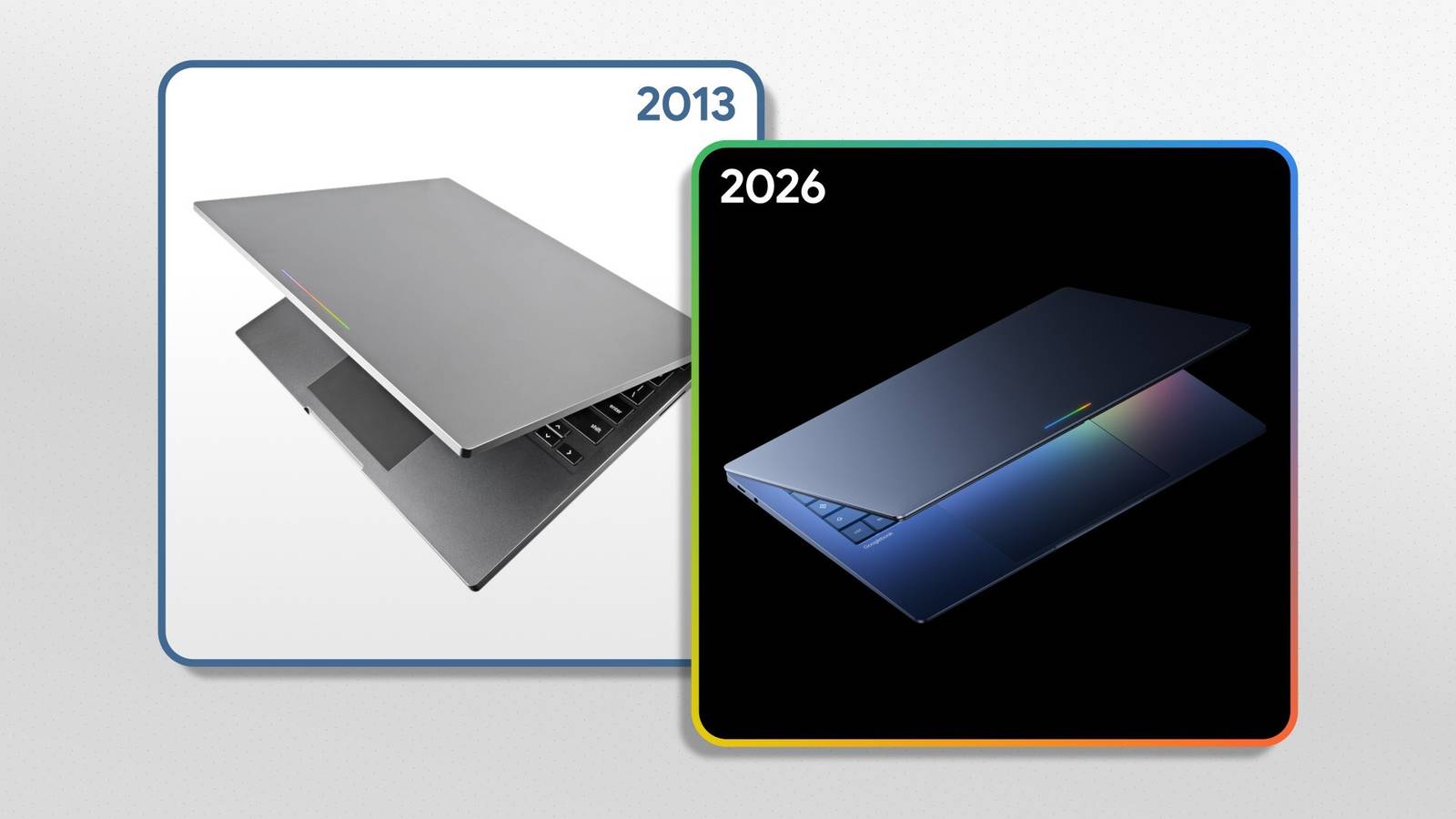
Google has announced a successor to the Chromebook, introducing a class of computer that merge together Android and Chrome OS, with a thick layer of Gemini on top.The first Googlebook, titled simply the Googlebook, is an attractive showpiece of a laptop—but I wouldn't feel comfortable buying one.Google has a history of making high-end laptops It just doesn't have a history of supporting them If you missed the news, take a look at the new Googlebook.
From what we've seen thus far, it's admittedly a gorgeous device.In fact, it hearkens back to my favorite laptop design ever made: the Chromebook Pixel.Released in 2013, the Chromebook Pixel was the first expensive splurge I made as an adult making money of my own.
I don't have personal photos lying around, but you can read about my love for the Pixel in 2014, back when I wrote for Android Police.This Pixel was an experiment.It was a $1,300 Chromebook at a time when most Chromebooks were known for being cheap $200 laptops, just as they are today.
It had an all-metal design and a gorgeous ultra-high-resolution screen.It was sleek and minimalist, and it was a computer I was happy to sit down at for work each day.While the Pixel had higher specs than other Chromebooks, this didn't matter all that much.
Aside from having enough processing power and RAM to run Chrome comfortably (though it is hard to imagine that 4GB was enough to run Chrome well back then), the software experience was otherwise identical.I couldn't do more with this laptop than I could on other Chromebooks—the experience was just nicer.Lenovo IdeaPad Flex 3i Chromebook Operating System Chrome OS CPU Intel Processor N100 Quad-Core GPU Integrated Intel UHD Graphics RAM 4GB DDR5 Storage 64GB Battery Up to 12 hours Untether the limits of your study space with an agile IdeaPad Flex 3i Chromebook.
Featuring an FHD IPS display and long battery life, your options stay wide open for web-browsing, study, or work, no matter where you go.Open your Chromebook to boot up in seconds, touch the screen to select and drag, and stay focused uninterruptedly and even into the night with a long battery life.$280 at Best Buy Expand Collapse The Chromebook Pixel did not become a permanent hardware line in the way the Apple MacBook had.
It received one upgrade in 2015, which was largely a spec bump with different ports.But Google wasn't done with the idea of selling a high-end PC.Unfortunately, Google has just one big idea for its laptops It keeps making the same promise over and over In 2017, Google released the most obvious successor to the Chromebook Pixel: the Pixelbook.
The price was still staggering, considering the base model started at $999, with configurations going all the way up to $1700.Unlike the Pixel, this was a convertible laptop with an optional pen.But already, the selling point was drifting away from Chrome OS and Android toward Google Assistant, which was given a button on the keyboard much like the CoPilot key on Windows PCs today.
In many ways, Google's sales pitch for the Pixelbook is the same as what we've just seen for the Googlebook.With Google Assistant, Google showed off newer ways of interacting with a computer.What if you could just pull up information by just asking? What if you could easily search by tapping a button and talking? What if you could use the pen and circle something to search? Ultimately, what if using a computer felt less like using a computer? Gemini can do more than Google Assistant, since the latter was hardly smashing two images together to create a poster or displaying how you look in new clothes.
Rather, the underlying premise is the same.Google isn't trying to sell you on apps and performance.While it's nice that the Googlebook can run native Android apps, that was a highlight of the Pixelbook as well, along with most Chromebooks to arrive since.
Likewise, it's good to see Google partner with Intel, but we've long been able to buy Chromebooks with Intel CPUs.Instead, Google's primary sales pitch remains: what if a computer was something you could control simply by telling it what to do? As Senior Director Alexander Kushner reiterated at the beginning of the most recent Android Show, Google no longer thinks of Android as an operating system but as an intelligence system.This is a vision Google has been working toward for decades.
The Pixelbook didn't live long enough to become a household name.It was succeeded by the Pixelbook Go in 2019, which was a cheaper, traditional clamshell laptop.That PC was quietly set aside in favor of the Pixel Slate and Pixel Tablet.
The Googlebook is a future I don't want Google continues to transform apps and the web for the worse My relationship with Google peaked the moment I bought the Chromebook Pixel.I loved what ChromeOS was back then, the radical idea of "what if all you needed was a web browser?" It wasn't about AI—it was about an open web.I liked a laptop that served as an incredibly sleek and attractive way to get online and do all of my work in the browser, the place where most of us office workers still do our work today.
Unfortunately, Google transformed the ChromeOS interface from its original minimalist design into the one we know today.Slowly but surely, Google introduced more Google branding and services throughout the experience.As a former Linux user, it pained me to have the computer that I loved transformed out from under me with no option to turn it back.
I eventually switched back to Linux.Still, I was so enamored with the hardware that I later gave Google another chance and purchased a Pixelbook.I'm not making the same mistake again.
With the Googlebook, Google hardly mentions Chrome OS or Android when talking about the device.It's all about Gemini and various manifestations of AI slop.I have looked forward to the emergence of Android-based laptops and was so excited for what the Googlebook could have been.
Yet while many of the AI features can be turned off, I'm done fighting Google for control of my computer.I don't want to buy a device from a company who views this product as a way to inject as much Gemini into our lives as possible and maximize data collection in the process.Other Android-based laptops are on the way.
If you like the idea of an Android-based PC, the Googlebook will not be your only option.Samsung is using this opportunity to produce Galaxy Books that ship with Android instead of Windows.In typical Samsung fashion, Galaxy Books will be offered in various pricing ranges, with some of those being high-end.
If I were going to buy an Android-based laptop, that would likely be the one I get.But I plan to stick with Linux.I have a pre-order for what I personally consider the most exciting laptop of the moment: the Framework 13 Pro.
At a time when Google is tripling down on amorphous and ever-shifting AI, I want a laptop that I actually own and control.
Read More